Recording transactions
Customer deposits and retainers: how to record them
Record customer deposits and retainers as unearned revenue, apply them to the final invoice, and handle refunds, forfeited deposits and retainer drawdowns.
By TNas · · 8 min read
Record a customer deposit or retainer by debiting Cash and crediting Unearned Revenue, a liability. The money is not revenue yet, because the business still owes the customer the work or goods. When the job is delivered, you move the deposit out of Unearned Revenue and into revenue, and invoice any balance still due.
This post walks through the full life of a deposit (receive it, apply it, refund it or keep it) and then the two common kinds of retainer.
Why a deposit is a liability, not revenue
Unearned revenue is money a customer pays before the business has done what it promised. It is a liability: if the business never delivers, it has to give the money back or deliver something of equal value. OpenStax's accounting textbook defines it as a customer's advance payment for a product or service and gives "lawyer retainer fees, and deposits for services" as examples (OpenStax, Current Liabilities).
Revenue is recorded when it is earned, which means when the business delivers the goods or service. That rule is called revenue recognition, and the lesson on revenue recognition at an introductory level explains it with more examples. Cash arriving early doesn't change when the revenue is earned.
Some businesses name the account Customer Deposits instead of Unearned Revenue. Either works. Pick one name, use it for every deposit, and report it with the other liabilities on the balance sheet.
A quick test: if the customer cancelled today, would you owe them anything? If yes, the money is still a liability.
Recording a deposit from start to finish
The example follows Bluebird Catering (a fictional business). A client books a $6,000 wedding dinner for April 12 and pays a 25% deposit, $1,500, on February 10. The balance is invoiced on the event date and due in 15 days.
Step 1: Receive the deposit
| Account | Debit | Credit |
|---|---|---|
| February 10: receive a 25% deposit for an April event | ||
| Cash | $1,500.00 | |
| Unearned Revenue | $1,500.00 | |
Cash goes up and so does the liability. Revenue and equity don't change. The lesson on collections, advances, and owner withdrawals uses the same entry for any customer who pays before the work.
Say Bluebird prepares statements for February and March. The $1,500 shows as a liability on both. No wedding revenue shows on either income statement.
Step 2: Deliver the work and apply the deposit
On April 12, Bluebird caters the wedding and invoices the client. The invoice shows the full $6,000 price, less the $1,500 deposit already paid, for $4,500 due. The entry recognizes all $6,000 of revenue at once and uses up the deposit:
| Account | Debit | Credit |
|---|---|---|
| April 12: event delivered, deposit applied, balance invoiced | ||
| Unearned Revenue | $1,500.00 | |
| Accounts Receivable | $4,500.00 | |
| Service Revenue | $6,000.00 | |
This compound entry does three things. It clears the liability. It records the $4,500 the client still owes in accounts receivable. And it puts the revenue in April, the month the work was done.
A common mistake is to record only the $4,500 as revenue because that's what the invoice asks for. That leaves $1,500 sitting in Unearned Revenue forever and understates April's revenue by the same amount.
Step 3: Collect the balance
| Account | Debit | Credit |
|---|---|---|
| April 27: client pays the balance | ||
| Cash | $4,500.00 | |
| Accounts Receivable | $4,500.00 | |
Across the three entries, Cash rose $6,000, revenue rose $6,000 and every other account is back to zero. That's a good check whenever you trace a deposit through the books. The lesson on invoicing and accounts receivable covers the collection step in more detail.
| Date | Cash | Unearned Revenue | Accounts Receivable | Service Revenue |
|---|---|---|---|---|
| Feb 10 | +$1,500 | +$1,500 | ||
| Apr 12 | −$1,500 | +$4,500 | +$6,000 | |
| Apr 27 | +$4,500 | −$4,500 | ||
| Net change | +$6,000 | $0 | $0 | +$6,000 |
Refunding a deposit
If the customer cancels and the deposit is refundable, the business returns the money and never earns any revenue. Suppose another Bluebird client paid an $800 refundable deposit and cancels:
| Account | Debit | Credit |
|---|---|---|
| May 3: refund a refundable deposit after cancellation | ||
| Unearned Revenue | $800.00 | |
| Cash | $800.00 | |
Nothing touches revenue, because no revenue was ever recorded. Refunding a customer who already paid a completed invoice is a different case with different entries; see how to record customer refunds the right way.
When the customer forfeits the deposit
Many contracts say a deposit is non-refundable, or only partly refundable, if the customer cancels. When that happens, the business no longer owes anything for that part, so the liability ends and the amount kept becomes revenue. Record it when the cancellation happens, not when the deposit was paid.
A client cancels a booking with a $1,000 non-refundable deposit:
| Account | Debit | Credit |
|---|---|---|
| May 10: client cancels and forfeits the full deposit | ||
| Unearned Revenue | $1,000.00 | |
| Cancellation Fee Revenue | $1,000.00 | |
A separate account such as Cancellation Fee Revenue keeps these amounts apart from catering sales. The income statement then shows how much came from events actually held. Some businesses use Other Revenue instead.
If the contract keeps only part of the deposit, split the entry. Here the client paid $1,200, and the contract lets Bluebird keep $300:
| Account | Debit | Credit |
|---|---|---|
| May 18: client cancels, part of the deposit is refunded | ||
| Unearned Revenue | $1,200.00 | |
| Cash | $900.00 | |
| Cancellation Fee Revenue | $300.00 | |
Always follow the signed contract. If it's unclear whether a deposit can be kept, leave it in Unearned Revenue until the question is settled.
How to record a retainer
A retainer is an upfront payment a client makes to secure a professional's services. It is common for consultants, designers, accountants and lawyers. There are two main kinds, and they are recorded differently.
A retainer drawn down against work
This is the most common kind. The client pays an amount in advance, and the professional applies it to invoices as work is done. Until work happens, it is unearned revenue.
Oak Hill Consulting (fictional) receives a $3,000 retainer on June 1:
| Account | Debit | Credit |
|---|---|---|
| June 1: receive a retainer to bill against hourly work | ||
| Cash | $3,000.00 | |
| Unearned Revenue | $3,000.00 | |
In June, Oak Hill does $1,800 of work. At month-end it applies part of the retainer:
| Account | Debit | Credit |
|---|---|---|
| June 30: apply the retainer to June's work | ||
| Unearned Revenue | $1,800.00 | |
| Service Revenue | $1,800.00 | |
In July it does $2,000 of work. Only $1,200 of the retainer is left, so it applies that and invoices the other $800:
| Account | Debit | Credit |
|---|---|---|
| July 31: use the rest of the retainer and invoice the difference | ||
| Unearned Revenue | $1,200.00 | |
| Accounts Receivable | $800.00 | |
| Service Revenue | $2,000.00 | |
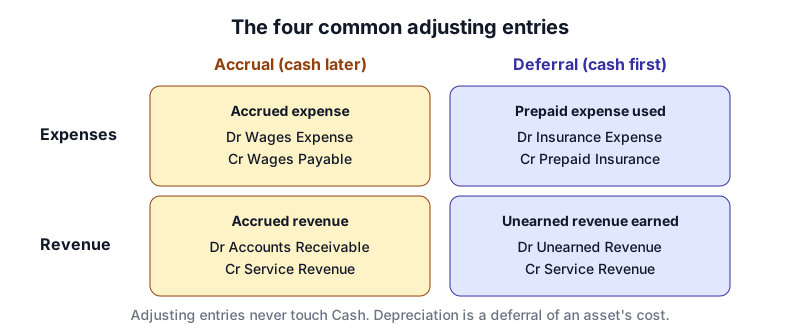
The month-end step is an adjusting entry of the deferral type. The lesson on deferrals shows the same calculation for prepaid services, and the adjusting entries cheat sheet puts it alongside the other adjustment types.
A retainer for availability
Some retainers pay for the professional to be available for a set period, for example a fixed monthly fee for advice on call, whatever the hours used. Here the service is being available, so the revenue is earned as the time passes. A three-month availability retainer paid up front would be recorded as Unearned Revenue and moved to revenue one month at a time.
Some professions, including law, have their own rules on how client funds such as retainers must be held. Check those rules before using the entries in this post for a regulated practice.
Keeping track of open deposits
A business with many open jobs can hold dozens of deposits at once. Unearned Revenue is one account in the ledger, but you need to know which customer each dollar belongs to. Treat it like a control account: keep a list of open deposits by customer and job, and make sure the list adds up to the ledger balance.
For example, Bluebird's list at March 31 might look like this:
| Customer | Event date | Deposit held |
|---|---|---|
| Wedding client | April 12 | $1,500.00 |
| Corporate lunch | April 20 | $600.00 |
| Birthday party | May 2 | $400.00 |
| Total (agrees to Unearned Revenue) | $2,500.00 |
If the list and the ledger disagree, look for two things. A deposit may have been applied to the wrong job. Or a finished job never had its deposit moved to revenue. Any deposit for an event date that has already passed needs a look. Either the work was done and the entry was missed, or the customer cancelled and the deposit should be refunded or forfeited under the contract.
Cash basis, tax and practical tips
A business that keeps its books on the cash basis records revenue when cash arrives, so it would record the deposit as revenue right away. The entries in this post are for the accrual basis, which records revenue when it is earned. The accrual vs cash basis worked examples show how the same deposit looks under each method.
Tax timing can differ from the books. IRS Publication 538 says an accrual-method taxpayer generally reports an advance payment as income in the year it is received. An election may let part of it be postponed to the next year (IRS Publication 538). Ask a tax professional how this applies to your business.
A few habits keep deposits clean:
| Habit | Why it helps |
|---|---|
| Track deposits by customer and job | You can see which jobs each dollar of Unearned Revenue belongs to |
| Show the deposit on the final invoice | The customer and the books agree on the balance due |
| Review Unearned Revenue at month-end | Old deposits for finished jobs signal a missed entry |
| Keep the contract with the deposit record | The refund or forfeit terms are in one place |
Frequently asked questions
Is a customer deposit taxable when received?
That depends on the tax rules, not the bookkeeping. Publication 538 describes the general rule and an optional deferral for accrual-method taxpayers. A tax professional can tell you which applies.
Where does a deposit go if the customer pays by card?
The same place. Only the debit changes if the card processor holds the money before paying it out; see how to record Stripe and PayPal payouts with fees for that clearing step.
What if the job is half finished at month-end?
Recognize the part that has been earned. If half of a deposited job is delivered by month-end, move half of the deposit from Unearned Revenue to revenue with an adjusting entry.
Practice deposits and unearned revenue next
Deposits test whether you can tell cash timing apart from earning. Start with revenue recognition practice to decide when revenue is earned. Then use adjusting entries practice for the month-end drawdown, and accounts receivable exercises for the final invoice with the deposit applied.
Sources
- 12.1 Identify and Describe Current Liabilities — OpenStax
- Publication 538, Accounting Periods and Methods — IRS
Educational content for US small-business bookkeeping, not tax, legal or accounting advice. Example businesses and figures are fictional. See our editorial policy for how we write and correct content.