Recording transactions
Equipment bought with financing: the full journal entries
Journal entries for financed equipment, from down payment and note payable to monthly interest and principal, depreciation, and year-end loan split.
By TNas · · 7 min read
When you buy equipment with financing, debit Equipment for the full cost, credit Cash for the down payment, and credit Notes payable for the amount borrowed. Each monthly payment then debits Interest expense for that month's interest and Notes payable for the rest. Separately, depreciation moves the equipment's cost to expense over its useful life, on a schedule that has nothing to do with the loan.
The walkthrough below follows one fictional purchase from signing to the first year-end. The business, Ridgeline Print Shop, and every figure are invented.
The example purchase
On February 1, 2026, Ridgeline Print Shop buys a large-format printer. The deal:
| Item | Amount |
|---|---|
| Printer price | 30,000.00 |
| Delivery | 400.00 |
| Installation and calibration | 600.00 |
| Total cost to capitalize | 31,000.00 |
| Down payment (cash, includes delivery and installation) | 6,000.00 |
| Financed with a note payable | 25,000.00 |
| Loan terms | 6% annual interest, 48 monthly payments |
The printer is installed and ready to use on February 1. Ridgeline estimates a five-year useful life and a $1,000 salvage value.
Step 1: work out the asset's cost
Equipment goes on the books at what it took to get it ready for use, not just the sticker price. The site's capitalizing fixed assets lesson puts it this way: purchase price plus costs such as delivery and installation. IRS Publication 946 describes the tax basis of purchased property as "its cost plus amounts you paid for items such as sales tax," and lists freight and installation and testing among the costs included.
Financing doesn't shrink the cost. Publication 946 says the cost "includes the amount you pay in cash, debt obligations, other property, or services." Ridgeline paid $6,000 in cash and $25,000 through a debt obligation, so the asset is $31,000. Recording only the $6,000 down payment is one of the most common fixed-asset errors: it understates both the asset and the loan.
If Ridgeline had paid sales tax on the printer, that tax would be part of the $31,000 too.
Step 2: record the purchase and the loan
One compound entry captures the whole transaction:
| Account | Debit | Credit |
|---|---|---|
| February 1: buy the printer with a down payment and a note | ||
| Equipment | $31,000.00 | |
| Cash | $6,000.00 | |
| Notes Payable | $25,000.00 | |
Notes payable is a liability for money owed under a signed promissory note, usually with interest (glossary). Ridgeline now has a $31,000 asset, $6,000 less cash and a $25,000 debt. The accounting equation balances: assets rose a net $25,000 and liabilities rose $25,000.
Some lenders pay the seller directly. The entry is the same: Ridgeline never touched the $25,000, but it owns the printer and owes the lender.
Step 3: split each loan payment
A $25,000 loan at 6% over 48 months has a level payment of $587.13. Ridgeline pays on the last day of each month, starting February 28, so each payment covers that month's interest.
Monthly interest is the unpaid balance × 6% ÷ 12, which is 0.5% a month. The rest of the payment reduces principal:
| Payment | Date | Payment | Interest | Principal | Balance after |
|---|---|---|---|---|---|
| Feb 1 | 25,000.00 | ||||
| 1 | Feb 28 | 587.13 | 125.00 | 462.13 | 24,537.87 |
| 2 | Mar 31 | 587.13 | 122.69 | 464.44 | 24,073.43 |
| 3 | Apr 30 | 587.13 | 120.37 | 466.76 | 23,606.67 |
Check payment 1: $25,000 × 0.5% = $125.00 interest, and $587.13 − $125.00 = $462.13 principal. Payment 2 starts from the lower balance: $24,537.87 × 0.5% = $122.69. Interest shrinks a little every month and principal grows. Your lender's amortization schedule is the source document; use its figures, because lenders sometimes count days rather than months.
The first payment entry:
| Account | Debit | Credit |
|---|---|---|
| February 28: payment 1 of 48 | ||
| Interest Expense | $125.00 | |
| Notes Payable | $462.13 | |
| Cash | $587.13 | |
And the second:
| Account | Debit | Credit |
|---|---|---|
| March 31: payment 2 of 48 | ||
| Interest Expense | $122.69 | |
| Notes Payable | $464.44 | |
| Cash | $587.13 | |
Only the interest is an expense. The principal portion repays borrowed money, the reverse of the day Ridgeline received it, so it reduces the liability. On a sole proprietor's tax return, the IRS Schedule C instructions give interest paid its own line (line 16). They add that interest paid this year that also applies to future years is deducted only for the part that applies to this year. Expensing the full $587.13 each month would overstate expenses by about $5,200 in the first year and leave Notes payable far too high. The planned post on recording a business loan covers amortization schedules in more depth.
Step 4: depreciate the equipment
Depreciation spreads the printer's cost over the years it helps the business earn revenue. It starts when the asset is ready for use. Publication 946 says "you place property in service when it is ready and available for a specific use." For Ridgeline, that's February 1.
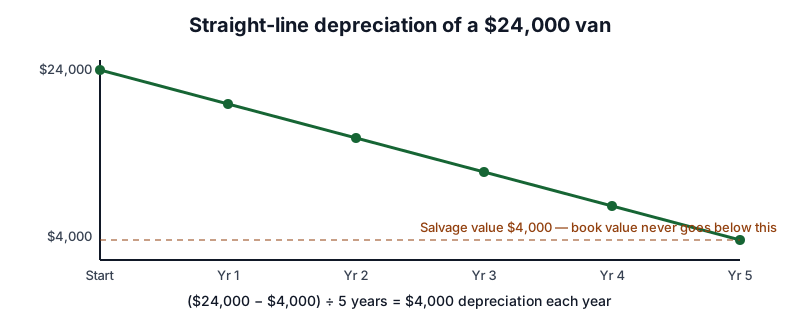
Using straight-line depreciation:
- Cost minus salvage value: $31,000 − $1,000 = $30,000
- Annual depreciation over a five-year useful life: $30,000 ÷ 5 = $6,000
- Monthly depreciation: $6,000 ÷ 12 = $500
Each month-end, Ridgeline records one month:
| Account | Debit | Credit |
|---|---|---|
| February 28: monthly depreciation on the printer | ||
| Depreciation Expense | $500.00 | |
| Accumulated Depreciation – Equipment | $500.00 | |
Accumulated depreciation is a contra-asset that builds up beside the Equipment account, which stays at $31,000. Under the monthly convention in the partial-year depreciation lesson, a printer in service from February 1 gets 11 months in 2026: $500 × 11 = $5,500.
The tax depreciation method can differ from this book method. Publication 946 covers the tax rules, and a tax professional can tell you which apply.
Why the loan and depreciation don't line up
New bookkeepers often expect the loan payment and depreciation to match. They don't, and they shouldn't. Depreciation follows the asset's useful life (five years here). The loan follows the lender's terms (four years). Ridgeline will own the printer outright after payment 48 while still depreciating it for another year. You could pay cash for the same printer and the depreciation entries would be identical.
Step 5: year-end balances and the loan split
By December 31, 2026, Ridgeline has made 11 payments (February through December).
| Account | Dec 31, 2026 | How it got there |
|---|---|---|
| Equipment | 31,000.00 | Cost, unchanged |
| Accumulated depreciation – Equipment | 5,500.00 | 11 months × 500.00 |
| Book value | 25,500.00 | 31,000.00 − 5,500.00 |
| Notes payable | 19,787.56 | 25,000.00 − 5,212.44 principal repaid |
| Interest expense for 2026 | 1,245.99 | Interest portion of 11 payments |
Two checks on those numbers. First, the 11 payments total $6,458.43 (11 × $587.13), which equals $1,245.99 of interest plus $5,212.44 of principal. Second, book value ($25,500.00) and the loan balance ($19,787.56) are different numbers measuring different things, so don't expect them to agree.
Current and long-term portions
On the balance sheet, a loan is split by when the principal is due. OpenStax explains that the part of a long-term note due in the current period is "considered a current portion of a note payable," and the rest stays long-term, in its chapter on current liabilities. The split uses principal only; future interest isn't a liability yet.
Ridgeline's schedule shows $6,022.13 of principal in payments 12 through 23 (January to December 2027). So at December 31, 2026:
| Classification | Amount |
|---|---|
| Current portion of notes payable | 6,022.13 |
| Long-term notes payable | 13,765.43 |
| Total notes payable | 19,787.56 |
Many small businesses keep one Notes payable account in the ledger and show the split only on the balance sheet. Others move the current portion to a separate account with a reclassification entry at year-end. Either is fine if the statement shows the split correctly.
Variations you'll run into
No down payment. Debit Equipment for the full cost and credit Notes payable for all of it. If you paid delivery separately, that's a second credit to Cash.
Loan fees. A documentation or origination fee charged by the lender is a financing cost, not part of the equipment's cost. How to record and spread it is worth confirming with your accountant.
Trade-in. Old equipment given as part of the payment has to be removed from the books, with its accumulated depreciation and any gain or loss, as shown in the asset disposals lesson.
Lease instead of a loan. Leases follow different rules. Check the agreement with your accountant before treating a lease as a purchase.
Frequently asked questions
Is the monthly equipment payment a business expense?
Only the interest part is an expense when you record it. The principal part reduces the loan. The equipment's cost reaches expense through depreciation instead.
Do I record the equipment at the price I'll pay including interest?
No. Record it at its cost on the purchase date. Interest is the price of borrowing money, and it's recognized month by month as Interest expense.
What if I miss posting the principal split and expense the whole payment?
Your expenses are overstated and Notes payable is too high. Compare the ledger to the lender's statement, then post a correcting entry that moves the principal from expense to Notes payable.
What to practice next
The depreciation side is the part most people get wrong under exam pressure. Work monthly, annual and partial-year calculations in depreciation practice, then build three-line purchase and payment entries in compound entry practice. The straight-line depreciation examples guide has more schedules to check your work against, and the planned post on vehicle purchase journal entries applies the same steps to a financed vehicle.
Sources
- Publication 946 (2025), How To Depreciate Property — IRS
- 12.1 Identify and Describe Current Liabilities — OpenStax, Principles of Accounting, Volume 1
- 2025 Instructions for Schedule C (Form 1040) — IRS
Educational content for US small-business bookkeeping, not tax, legal or accounting advice. Example businesses and figures are fictional. See our editorial policy for how we write and correct content.