Recording transactions
How to record a vehicle purchase for a small business
Journal entries for buying a business vehicle, including which fees to capitalize, a trade-in, a loan, and the first month of depreciation.
By TNas · · 9 min read
To record a vehicle purchase, debit a Vehicles asset account for the full cost of getting the vehicle on the road and credit whatever paid for it: Cash, a loan (Notes payable), a trade-in, or a mix. The vehicle is not an expense on the day you buy it. Its cost reaches the income statement gradually through depreciation over the years the business uses it.
This post walks through one fictional purchase from start to finish: working out the cost from the dealer invoice, recording a trade-in, financing the balance, and posting the first depreciation and loan payment. All businesses, people and figures here are made up for the examples.
Why a vehicle is an asset, not an expense
A vehicle the business will use for several years is a fixed asset. An asset is a resource the business controls that will bring benefit in future periods, and a truck used for five years clearly does. Recording it as an expense would make the purchase month look like a large loss and every later month look better than it really was.
The rule that ties a cost to the periods it helps is the matching principle. For a vehicle, matching happens through depreciation: a slice of the cost becomes expense each month the vehicle is in service.
The site's lesson on capitalizing fixed assets covers the general rule. Capitalizing means recording a cost as part of an asset instead of as an expense. A vehicle follows the same logic as other equipment, for example an oven or a computer.
What goes into the vehicle's cost
The asset is recorded at cost: the purchase price plus the costs needed to get the vehicle ready for use. The IRS lists sales tax, freight, and installation and testing among the costs included in the basis of property you buy (IRS Publication 551). Your books and your tax return can differ in places, but for a straightforward purchase the same items usually go into cost on both.
Recurring running costs, such as registration renewals and insurance, are different. They keep the vehicle legal and insured for a period of time, so they belong to that period.
| Item on the dealer invoice | Treatment | Account |
|---|---|---|
| Vehicle price | Capitalize | Vehicles |
| Sales tax on the vehicle | Capitalize | Vehicles |
| Dealer documentation fee | Capitalize | Vehicles |
| Title fee | Capitalize | Vehicles |
| Delivery or destination charge | Capitalize | Vehicles |
| Upfitting needed before use (racks, toolboxes) | Capitalize | Vehicles |
| Annual registration | Expense (or prepay if large) | Taxes and licenses expense |
| Insurance policy | Prepaid asset, then expense monthly | Prepaid insurance |
| Extended warranty or service plan | Prepaid asset over its term | Prepaid expenses |
| First tank of fuel | Expense | Vehicle expense |
Read the dealer's buyer's order line by line before you post anything. It is the source document for the entry, and it usually shows each fee, the trade-in allowance and the amount financed separately.
The example: a landscaping company buys a pickup
On March 1, fictional Ridgeline Landscaping buys a new pickup truck. The buyer's order shows:
| Line | Amount |
|---|---|
| Vehicle price | $42,000.00 |
| Dealer documentation fee | $400.00 |
| Title fee | $150.00 |
| Sales tax (fictional 6% of the price) | $2,520.00 |
| Annual registration | $200.00 |
| Total due | $45,270.00 |
| Less trade-in allowance for the old truck | ($8,000.00) |
| Less cash down payment | ($5,000.00) |
| Amount financed (note payable) | $32,270.00 |
The capitalized cost is the price plus the three capitalizable items: $42,000 + $400 + $150 + $2,520 = $45,070. The $200 registration covers one year of road use, so Ridgeline expenses it. (A business with a large registration bill could record it as a prepaid expense and spread it over 12 months.)
Sales tax rules differ by state, including whether a trade-in reduces the taxable amount. Use the figures on your invoice rather than recalculating them.
Simplest case: paid in full with cash
If Ridgeline had no trade-in and no loan, the entry would just swap one asset for another:
| Account | Debit | Credit |
|---|---|---|
| March 1: buy the truck for cash | ||
| Vehicles | $45,070.00 | |
| Taxes and Licenses Expense | $200.00 | |
| Cash | $45,270.00 | |
Total assets barely move: Cash falls and Vehicles rises by nearly the same amount. Only the registration reduces equity. The lesson on how transactions affect the equation calls this an asset swap.
Recording a trade-in
A trade-in is two transactions on the same day: Ridgeline sells its old truck to the dealer and uses the sale price (the trade-in allowance) as part payment for the new one.
The old truck originally cost $30,000. Its accumulated depreciation is $24,000 after recording depreciation up to March 1, so its book value is $30,000 − $24,000 = $6,000. The dealer allows $8,000 for it.
The difference is a gain on disposal: $8,000 allowance − $6,000 book value = $2,000 gain. If the allowance had been $5,000, Ridgeline would record a $1,000 loss instead.
Before you record the trade-in, bring the old truck's depreciation up to the trade-in date. Skipping this step overstates book value and misstates the gain or loss. The lesson on disposing of fixed assets covers this in more detail.
For tax purposes, the IRS says the like-kind exchange rules apply only to exchanges of real property (IRS Publication 544), so a vehicle trade-in is not handled as a like-kind exchange. How the gain is reported on a return is a question for a tax professional; the bookkeeping entry below records what happened.
The full purchase entry with trade-in and loan
Here is Ridgeline's complete March 1 entry. It is a compound entry because it has more than one debit and more than one credit:
| Account | Debit | Credit |
|---|---|---|
| March 1: buy the new truck with a trade-in, down payment and loan | ||
| Vehicles | $45,070.00 | |
| Taxes and Licenses Expense | $200.00 | |
| Accumulated Depreciation – Vehicles | $24,000.00 | |
| Vehicles | $30,000.00 | |
| Gain on Disposal of Assets | $2,000.00 | |
| Cash | $5,000.00 | |
| Notes Payable | $32,270.00 | |
Check it line by line:
- Debits: $45,070 + $200 + $24,000 = $69,270.
- Credits: $30,000 + $2,000 + $5,000 + $32,270 = $69,270.
- The first Vehicles line adds the new truck at its full cost. The second removes the old truck's original cost.
- The Accumulated depreciation debit clears everything recorded against the old truck, so nothing is left behind for an asset the business no longer owns.
- Notes payable records the loan for the amount financed on the buyer's order.
Many businesses keep a fixed asset register with one row per vehicle, so it is clear which cost and which accumulated depreciation belong to which truck. Your accounting software may handle this through a fixed asset list.
Never net the trade-in against the new truck's cost (recording the new truck at $37,070). That hides the old truck's removal, leaves its cost and accumulated depreciation on the books, and skips the gain or loss.
Starting depreciation
Depreciation begins when the vehicle is placed in service, meaning ready and available for use, not when the invoice is paid. Ridgeline starts using the truck on March 1.
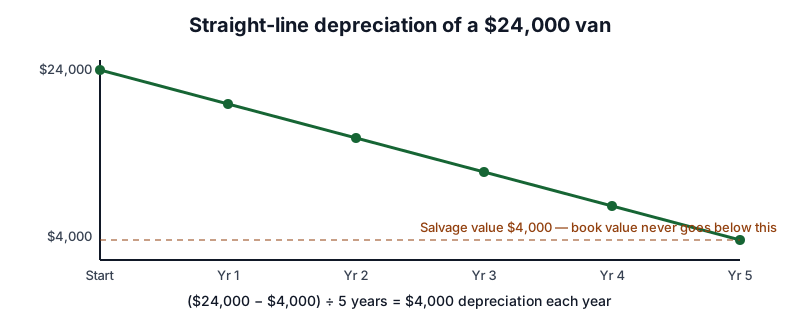
Using straight-line depreciation with a fictional five-year useful life and a salvage value of $9,070:
- Depreciable base: $45,070 − $9,070 = $36,000
- Annual depreciation: $36,000 ÷ 5 = $7,200
- Monthly depreciation: $7,200 ÷ 12 = $600
| Account | Debit | Credit |
|---|---|---|
| March 31: first month of depreciation | ||
| Depreciation Expense | $600.00 | |
| Accumulated Depreciation – Vehicles | $600.00 | |
Under a monthly convention, a truck placed in service on March 1 gets 10 months of depreciation in its first calendar year (March through December), or $6,000. The lesson on partial-year depreciation explains the counting.
This is book depreciation. Tax depreciation for vehicles follows its own rules: the IRS notes that MACRS is generally the method car owners use and that there are limits on how much depreciation can be deducted (IRS Topic no. 510). Many small businesses keep book and tax depreciation in separate schedules and let their tax preparer handle the tax side.
Recording the loan payments
Each loan payment has two parts. The interest part is an expense for the month. The principal part reduces the amount owed on the note.
Ridgeline's fictional loan carries 6% annual interest with a monthly payment of $650. The first month's interest is $32,270 × 6% ÷ 12 = $161.35. The rest of the payment, $650.00 − $161.35 = $488.65, reduces the principal.
| Account | Debit | Credit |
|---|---|---|
| April 1: first loan payment | ||
| Notes Payable | $488.65 | |
| Interest Expense | $161.35 | |
| Cash | $650.00 | |
After this payment the note balance is $32,270.00 − $488.65 = $31,781.35. Next month's interest is calculated on that lower balance, so the interest part shrinks a little each month and the principal part grows. Take the exact split from the lender's statement or amortization schedule each month.
The most common error here is debiting the full $650 to an expense account. That understates profit and leaves the Notes payable balance too high, so it no longer matches the lender's statement. The planned post on recording a business loan covers amortization schedules in more depth.
Business and personal use
If a vehicle is used partly for personal trips, the books still record the business asset, but the owner and tax preparer need to know the business-use share. The IRS describes two ways to figure the deduction for business use of a car, the standard mileage rate method and the actual expense method, and says expenses must be substantiated by adequate records (IRS Topic no. 510).
For the bookkeeping, that means:
- Keep a mileage log or other record that shows business and personal use.
- Record fuel, repairs and insurance to the right expense accounts as they happen.
- If the owner uses a business vehicle for personal trips in a sole proprietorship, discuss with a tax professional how to treat that use. Don't guess at a split in the books.
Frequently asked questions
Should a small vehicle purchase ever be expensed immediately?
In the books, a vehicle used for several years is almost always capitalized, because its cost is far above any typical capitalization threshold. Tax rules may allow faster deductions in some cases, but that is a tax-return decision, not a reason to skip the asset in your general ledger.
What if I bought the vehicle from a private seller?
The entry is the same, without dealer fees. Debit Vehicles for the price plus any sales tax and title fees you paid, and credit Cash or the loan. Keep the bill of sale as your source document.
Where does the loan appear on the balance sheet?
Notes payable is a liability. The part due within the next 12 months is usually shown as current and the rest as long-term on the balance sheet.
What happens when I sell the vehicle later without buying another?
Record depreciation up to the sale date, remove the vehicle's cost and accumulated depreciation, debit Cash for the proceeds, and record the difference as a gain or loss. It is the trade-in entry without the new vehicle lines.
What to practice next
Vehicle purchases combine three skills: capitalizing cost, removing an old asset, and splitting loan payments. Build each one with the depreciation exercises, then try the asset disposal exercises for trade-ins and sales. When you are ready to put several debits and credits in one entry, work through the compound journal entry exercises. For a related purchase, the planned post on equipment bought with financing follows the same pattern for machinery.
Sources
- Publication 551, Basis of Assets — IRS
- Topic no. 510, Business use of car — IRS
- Publication 544, Sales and Other Dispositions of Assets — IRS
Educational content for US small-business bookkeeping, not tax, legal or accounting advice. Example businesses and figures are fictional. See our editorial policy for how we write and correct content.