Recording transactions
Owner contributions and draws: journal entries explained
How to record owner contributions and draws for a sole proprietor or LLC, why draws are not expenses, and how to close Owner Drawings at year-end.
By TNas · · 7 min read
An owner contribution is recorded by debiting the asset the owner puts in (usually Cash) and crediting Owner Capital. An owner draw is the reverse direction: debit Owner Drawings and credit Cash. Neither one is revenue or an expense, because both are transactions between the business and its owner, not with customers or suppliers.
This post covers the entries for sole proprietors and LLCs that keep owner equity accounts, why draws stay off the income statement, and how Owner Drawings is closed at year-end.
What owner equity accounts track
Equity is the owner's claim on the business: what would be left if every asset were sold and every liability paid. For a sole proprietor or single-member LLC, equity usually lives in two accounts.
- Owner Capital is the running total of what the owner has put into the business plus profits kept in it. It has a normal credit balance.
- Owner Drawings is the account that collects what the owner takes out during the year for personal use. It has a normal debit balance, because it reduces equity.
Some charts of accounts use other names, such as Owner's Equity, Owner Investment or Owner's Draw. The names change; the logic doesn't. The lesson on debits and credits for contra accounts and drawings explains why Owner Drawings grows with debits even though it sits in equity.
How to record owner contributions
A contribution is anything of value the owner puts into the business without expecting to be repaid on loan terms. Every contribution credits Owner Capital. What you debit depends on what came in.
The examples below follow Lena Park, who runs Park Lane Cleaning (a fictional sole proprietorship).
Cash contribution
On January 2, Lena moves $10,000 from her personal savings into the business checking account:
| Account | Debit | Credit |
|---|---|---|
| January 2: owner contributes cash | ||
| Cash | $10,000.00 | |
| Owner Capital | $10,000.00 | |
This is the same entry the lesson on collections, advances, and owner withdrawals uses: an owner investment is a cash receipt credited to Owner Capital, not to revenue.
Contribution of equipment or other assets
On January 5, Lena starts using a carpet cleaning machine she already owned. It is worth $1,500 on that date. The business now has an asset it didn't pay for, and her equity rises by the same amount:
| Account | Debit | Credit |
|---|---|---|
| January 5: owner contributes equipment | ||
| Equipment | $1,500.00 | |
| Owner Capital | $1,500.00 | |
Record a non-cash contribution at a supportable value on the day it enters the business, such as what similar used equipment sells for. Keep a note of how you got the figure. The value for tax depreciation can follow different rules, so check with a tax professional before using this figure on a return.
Business bill paid with personal money
On February 8, Lena pays the business's $180 phone bill with her personal card. The business got the service, so the expense is real. No business cash left, so the credit goes to Owner Capital instead of Cash:
| Account | Debit | Credit |
|---|---|---|
| February 8: owner pays a business bill personally | ||
| Utilities Expense | $180.00 | |
| Owner Capital | $180.00 | |
This entry keeps the expense in the business's books, where it belongs. Does Lena expect the business to pay her back? Then credit a liability such as Due to Owner instead. Debit that liability when the business repays her.
A contribution is not a loan. If the owner lends money on agreed terms and expects repayment, record a liability, as shown in how to record a business loan and its payments. If there's no repayment plan, it's capital.
How to record owner draws
A draw is money or property the owner takes out of the business for personal use. Every draw debits Owner Drawings.
On the last day of each month, Lena transfers $2,000 to her personal account:
| Account | Debit | Credit |
|---|---|---|
| January 31: owner takes a monthly draw | ||
| Owner Drawings | $2,000.00 | |
| Cash | $2,000.00 | |
On March 14, she accidentally buys $120 of personal groceries with the business debit card. The business paid for something that isn't a business cost, so it is treated as a draw:
| Account | Debit | Credit |
|---|---|---|
| March 14: personal purchase on the business card | ||
| Owner Drawings | $120.00 | |
| Cash | $120.00 | |
If the personal purchase went on a business credit card instead of a debit card, the credit side is the card's liability account rather than Cash. The full pattern is in how to record business credit card purchases and payments.
Why a draw is not an expense
An expense is a cost of earning revenue: rent, supplies, wages for employees. A draw doesn't help earn anything. It is the owner taking part of the equity they already have, so it reduces equity directly without passing through the income statement.
The IRS treats it the same way for sole proprietors. Publication 334 says "you can't deduct your own salary or any personal withdrawals you make from your business" (IRS Publication 334). In other words, a sole proprietor's draws don't lower business profit. The owner's income tax is figured on the business's profit, not on how much was drawn.
Recording draws as wages or "owner salary expense" understates profit on the income statement. It also makes the business look more expensive to run than it is, which can mislead a lender or a buyer reading the statements.
Keep draws easy to trace
IRS Publication 583 advises opening a business checking account, keeping it separate from personal accounts, and writing checks payable to yourself only when withdrawing business money for personal use (IRS Publication 583). Transfers work the same way. One regular transfer to a personal account is far easier to record than personal purchases mixed in with business ones.
Closing Owner Drawings at year-end
Owner Drawings is a temporary account. It measures one year's withdrawals, so it must start each year at zero. At year-end, its balance is moved into Owner Capital as the last of the four closing entries.
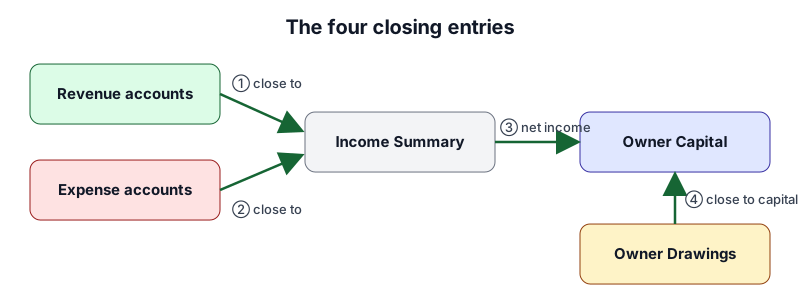
Suppose Park Lane Cleaning earned net income of $31,000 for the year (after the revenue and expense accounts were closed to Income Summary). Lena drew $2,000 a month for 12 months, plus the $120 personal purchase, for total drawings of $24,120.
First, net income moves from Income Summary to Owner Capital. Then drawings are closed:
| Account | Debit | Credit |
|---|---|---|
| December 31: close Income Summary to Owner Capital | ||
| Income Summary | $31,000.00 | |
| Owner Capital | $31,000.00 | |
| December 31: close Owner Drawings to Owner Capital | ||
| Owner Capital | $24,120.00 | |
| Owner Drawings | $24,120.00 | |
Notice that drawings are closed straight to Owner Capital, not through Income Summary. Income Summary only collects revenue and expenses, and drawings are neither. The lesson on closing entries walks through all four steps in order.
The statement of owner's equity
The statement of owner's equity shows how Owner Capital changed during the year. For Lena's first year, starting from zero:
| Line | Amount |
|---|---|
| Beginning Owner Capital, January 1 | $0.00 |
| Add: owner contributions ($10,000 + $1,500 + $180) | $11,680.00 |
| Add: net income | $31,000.00 |
| Less: owner drawings | ($24,120.00) |
| Ending Owner Capital, December 31 | $18,560.00 |
Check it against the ledger: $10,000 + $1,500 + $180 + $31,000 − $24,120 = $18,560. After closing, the Owner Capital account in the general ledger should show exactly that balance. It is also the equity figure on the year-end balance sheet. The lesson on the statement of owner's equity covers the layout in more detail.
When drawings exceed capital
If an owner draws more than they contributed plus the profits kept in the business, Owner Capital can end up with a debit balance (negative equity). The entries are still correct. Still, negative equity means the owner has taken out more than the business has built up. It is worth a conversation with an accountant.
Partnerships and multi-member LLCs
When a business has more than one owner, each owner gets their own pair of accounts. For example: Owner Capital (Lena) and Owner Drawings (Lena), plus Owner Capital (Sam) and Owner Drawings (Sam). Contributions and draws are recorded to the owner who made them. At year-end, net income is split according to the ownership agreement and credited to each owner's capital account. Each owner's drawings are closed to their own capital.
Partners are not paid wages the way employees are. The IRS page on paying yourself states that partners are not employees and shouldn't be given a Form W-2 (IRS, Paying yourself). Payments a partnership makes to its partners have their own tax reporting, so a tax professional should set up how those are recorded.
Corporations work differently
A corporation doesn't use Owner Capital and Owner Drawings. Owners hold shares, profits build up in retained earnings, and payments to owners are either wages (through payroll) or distributions or dividends. The same IRS page notes that a corporate officer who performs services is generally an employee. If your LLC has elected to be taxed as a corporation, ask your accountant which accounts to use before recording any owner payments.
Frequently asked questions
Is an owner's draw taxable?
For a sole proprietor, the draw itself doesn't change the tax: the owner is taxed on the business's profit whether the money is drawn or left in the account. Publication 334 says personal withdrawals can't be deducted. Ask a tax professional about your own situation.
Can I record a draw as a reduction of Owner Capital directly?
Some small businesses do, and the ending balance comes out the same. A separate Owner Drawings account is still better: it shows the year's total withdrawals at a glance and makes the statement of owner's equity easy to prepare.
What if I pay myself from the business on a regular schedule?
A fixed monthly draw is common and makes cash planning easier. It is still a draw, recorded to Owner Drawings, not wages, as long as the business is a sole proprietorship or an LLC taxed as one.
Practice owner equity entries next
Owner entries look simple, but students often mix up which side Owner Capital and Owner Drawings belong on. Drill the contribution and draw entries in journal entry practice. Then build a full year-end picture with statement of owner's equity practice and closing entries practice.
Sources
- Publication 334 (2025), Tax Guide for Small Business — IRS
- Publication 583, Starting a Business and Keeping Records — IRS
- Paying yourself — IRS
Educational content for US small-business bookkeeping, not tax, legal or accounting advice. Example businesses and figures are fictional. See our editorial policy for how we write and correct content.