Bookkeeping careers
Accounts payable clerk vs bookkeeper: which job fits
How an accounts payable clerk and a bookkeeper differ in scope, daily tasks and skills, with example entries and how to move from one role to the other.
By TNas · · 7 min read
An accounts payable clerk handles one process, the bills a business owes its suppliers, from the day a bill arrives until it is paid. A bookkeeper is responsible for the whole set of books, or a large part of it, including payables, receivables, cash and month-end reports. Pick AP if you want a focused, process-driven role in a larger team; pick bookkeeping if you want breadth and ownership of the full picture.
The two jobs share the same accounting rules, which is why people often move from one to the other. Here is how they compare in practice.
The short answer: scope
The difference is how much of the general ledger you touch.
An accounts payable clerk is a specialist who records supplier bills, gets them approved, pays them on time and keeps vendor records clean. Accounts payable is the liability account for money the business owes suppliers, and the clerk's job is to keep it accurate.
A bookkeeper is the person who keeps a business's financial records complete and correct across every account. The U.S. Bureau of Labor Statistics (BLS) says bookkeeping clerks often maintain some or all of an organization's general ledger. Full-charge bookkeepers also prepare financial statements and make bank deposits. They may handle payroll, purchasing, invoicing and overdue accounts as well (BLS Occupational Outlook Handbook).
The BLS describes accounting clerks as usually working for larger companies on more specialized tasks. Their titles, such as accounts payable clerk, reflect the type of accounting they do. So an AP clerk is most common where the volume of bills justifies a dedicated person. A small business rarely has one; its bookkeeper does the AP work.
| Accounts payable clerk | Bookkeeper | |
|---|---|---|
| Scope | Supplier bills, payments, vendor records | Some or all of the general ledger |
| Typical employer | Larger companies with many bills | Small and mid-size businesses, firms serving clients |
| Main accounts | Accounts payable, expenses, inventory, cash | Every account in the chart of accounts |
| Month-end role | Reconcile AP, flag unrecorded bills | Reconcile all accounts, post adjustments, prepare statements |
| Works with | Purchasing, approvers, suppliers | Owners, managers, outside accountants |
A day in accounts payable
AP work follows a cycle that repeats every day and every week.
Receiving and checking bills
A supplier bill arrives. The clerk checks it against what was ordered and what was received. They confirm the price and code it to the right account. Many companies call this matching. A bill that doesn't match goes back to purchasing or the supplier before anyone records it.
Keeping vendor records
AP clerks usually collect tax information from vendors. Form W-9 is how a payee gives its correct Taxpayer Identification Number to a business that must file an information return with the IRS (IRS: About Form W-9). One of those returns is Form 1099-NEC, which the IRS says is used to report nonemployee compensation (IRS: About Form 1099-NEC). Which vendors need a 1099 depends on IRS rules, so AP teams follow the IRS instructions or their tax adviser rather than guessing.
Recording and paying a bill
Once a bill is approved, the clerk records it. Suppose a fictional landscaping company receives a $640 bill for supplies on 30-day payment terms. Nothing is paid on day one. The liability sits in Accounts payable, and the supplier's balance appears in the AP subledger. On the due date, after approval, the clerk pays it:
| Account | Debit | Credit |
|---|---|---|
| May 3: record the supplier bill | ||
| Supplies | $640.00 | |
| Accounts Payable | $640.00 | |
| June 2: pay the supplier | ||
| Accounts Payable | $640.00 | |
| Cash | $640.00 | |
Payment runs are where AP controls matter most. The clerk confirms a bill hasn't already been paid. They check that a vendor's bank details haven't been changed without verification. Only approved bills go out. The paying suppliers lesson covers payments, partial payments and discounts.
Month-end in AP: reconciling payables
A subledger is a detailed record behind one general ledger account, here a list of balances by vendor. At month-end, the AP subledger total must equal the Accounts payable control account in the general ledger. Supplier statements are compared with the vendor balances too. Differences usually point to a missing bill, a duplicate, or a payment posted to the wrong vendor. The reconciling payables lesson walks through the process.
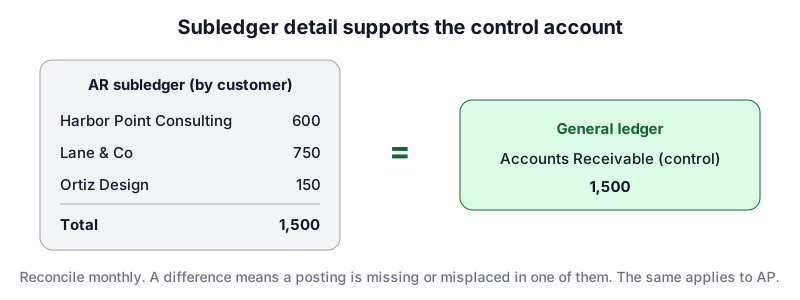
The clerk also looks for bills that belong to the month but haven't been entered yet, such as services received before the invoice arrives. Those become part of the month-end adjustments covered below.
A day as a bookkeeper
A bookkeeper does all of the above when there is no separate AP clerk, plus the rest of the books.
Daily and weekly work
- Recording sales invoices and customer payments (accounts receivable)
- Coding bank and card transactions
- Recording deposits, as the BLS lists among a full-charge bookkeeper's duties
- Running payroll, in many small businesses
Month-end work
Month-end is where the jobs separate most. The bookkeeper reconciles every bank and card account, then posts adjusting entries for things no bill or bank line has captured yet. Two common ones, using fictional figures:
| Account | Debit | Credit |
|---|---|---|
| May 31: accrue the May utility bill that arrives in June | ||
| Utilities Expense | $310.00 | |
| Utilities Payable | $310.00 | |
| May 31: record monthly depreciation on equipment | ||
| Depreciation Expense | $250.00 | |
| Accumulated Depreciation | $250.00 | |
The utility accrual matters to AP too: a bill for May services that arrives in June still belongs in May. An AP clerk may flag it; the bookkeeper decides and records the adjustment. The accruals lesson explains why.
After adjustments, the bookkeeper reviews the trial balance and prepares the income statement and balance sheet. The month-end close checklist lists the full sequence.
Skills: where the jobs overlap and differ
Both jobs rest on the same foundation. The BLS lists analytical skills, computer skills, attention to detail, integrity and math skills as important qualities for the whole occupation.
| Skill | AP clerk | Bookkeeper |
|---|---|---|
| Debits and credits | Daily, within AP | Daily, across all accounts |
| Matching documents | Core skill | Used regularly |
| Vendor communication | Core skill | Occasional |
| Payment controls | Core skill | Shared with owner or manager |
| Bank reconciliation | Rare | Core skill |
| Adjusting entries | Rare | Core skill |
| Financial statements | Rare | Core skill |
AP rewards consistency and process discipline at high volume. Bookkeeping rewards judgment across many accounts, because each month brings transactions that don't fit a routine.
Pay and outlook
The BLS doesn't publish separate figures for AP clerks. It counts them in the same occupation as bookkeepers: bookkeeping, accounting, and auditing clerks. For that whole group, the median annual wage was $50,670 in May 2025. Employment is projected to decline 6% over the decade, with about 144,100 openings a year from replacement needs (BLS, May 2025 wages and 2025 to 2035 projections).
The BLS gives software automation as the main reason for the decline, and it expects these workers to take on more analytical and advisory work. Routine bill entry is one of the easier tasks to automate, which is a good reason for an AP clerk to build reconciliation and month-end skills too. For the broader picture, see is bookkeeping a good career.
Which job fits you?
An AP role may suit you if you:
- Like a clear, repeatable process and measurable daily output
- Want to work inside a larger finance team with a manager to learn from
- Are comfortable being the person who checks, questions and says no to an unapproved payment
A bookkeeping role may suit you if you:
- Want to see how every part of the business connects
- Enjoy solving a different problem each month
- Are ready to be responsible for statements that an owner or accountant relies on
Moving from AP to bookkeeping
AP is a common entry point, and the move to bookkeeping is a natural one. You already know debits and credits, the AP cycle and subledger reconciliation. The gaps are usually:
- Receivables: invoicing, collections and customer credits (invoicing and receivables lesson)
- Bank reconciliation across all accounts (bank reconciliation basics)
- Adjusting entries and accruals
- Preparing and reading financial statements
Fill those gaps, and an AP background becomes a strong case in an interview. The AP and AR interview questions are a good check of where you stand.
Frequently asked questions
Is an accounts payable clerk a bookkeeper?
Not exactly. The BLS puts both in one occupation, but an AP clerk specializes in supplier bills, while a bookkeeper maintains some or all of the general ledger.
Is AP or bookkeeping easier to get into?
Both commonly start with on-the-job training. AP roles have a narrower scope to learn first, but they are concentrated in larger companies. Bookkeeping jobs exist in businesses of every size.
Does an AP clerk need to know accounting?
Yes. Every bill and payment is a double-entry transaction, and reconciling AP means understanding how the subledger ties to the control account.
What to practice next
Whichever role you aim for, start with the work they share. Record bills, payments and discounts in the accounts payable practice set, then add the bookkeeper's month-end skills with adjusting entries practice. The accounts payable examples guide walks through the entries an AP clerk records every day.
Sources
- Bookkeeping, Accounting, and Auditing Clerks (Occupational Outlook Handbook) — U.S. Bureau of Labor Statistics
- About Form W-9, Request for Taxpayer Identification Number and Certification — IRS
- About Form 1099-NEC, Nonemployee Compensation — IRS
Educational content for US small-business bookkeeping, not tax, legal or accounting advice. Example businesses and figures are fictional. See our editorial policy for how we write and correct content.