Bookkeeping careers
Build a bookkeeping portfolio with practice projects
Which practice projects prove bookkeeping skill, how to document a month-end close with memos and reconciliations, and how to present the work to employers.
By TNas · · 7 min read
A bookkeeping portfolio is a set of three to five finished practice projects that show an employer you can record transactions, reconcile accounts and close a month correctly. The best projects copy real bookkeeping work. Take a month of source documents for a fictional business all the way through a bank reconciliation, adjusting entries, an adjusted trial balance and financial statements. Each one should be documented so a reviewer can check your work in a few minutes.
A portfolio matters most when you have no bookkeeping job on your résumé yet. It replaces "I've studied bookkeeping" with evidence. This guide covers which projects to build, how to document them and how to present them.
What a portfolio has to prove
Start from the job, not the projects. The U.S. Bureau of Labor Statistics lists these duties for bookkeeping, accounting and auditing clerks (BLS Occupational Outlook Handbook):
- use bookkeeping software, spreadsheets and databases
- enter (post) financial transactions
- receive and record cash, checks and vouchers
- produce reports such as balance sheets, income statements and totals by account
- check figures, postings and reports for accuracy
- reconcile records and report any differences
A useful benchmark for scope comes from the AIPB, which describes its Certified Bookkeeper designation as covering all bookkeeping functions through the adjusted trial balance, including basic payroll (AIPB student handbook). A portfolio that reaches the adjusted trial balance and statements covers that ground.
Projects that show real skill
Each project below proves a different part of the job. You don't need all six. Pick three to five that match the roles you're applying for.
| Project | What it proves | Core artifacts |
|---|---|---|
| A month for a service business | Recording from source documents | Journal, general ledger, trial balance |
| Bank reconciliation | Matching, finding errors, book adjustments | Reconciliation sheet, adjusting entries |
| Receivables and payables tie-out | Subledgers agree with control accounts | Aged lists, control account balances |
| Month-end adjustments | Accruals and deferrals, cutoff | Adjusting entries with memos, adjusted trial balance |
| Financial statements and close | Reporting and closing entries | Income statement, balance sheet, closing entries |
| Cleanup and corrections | Finding and fixing mistakes | Error log, correcting entries |
A month for a service business
Take a fictional business through one month of transactions from source documents: invoices, receipts, a bank statement. Record each journal entry, post to the ledger and prepare a trial balance. A ready-made case such as the freelance design studio project gives you documents and opening balances to work from.
Bank reconciliation
Reconcile a month's bank statement against the book Cash account, identify the timing items and record the book-side adjustments. Show the finished reconciliation with both adjusted balances equal. The bank reconciliation guide shows the layout.
Receivables and payables tie-out
Show that the customer and supplier subledgers total to the Accounts receivable and Accounts payable control accounts. This tie-out is everyday work in accounts payable and receivable roles.
Month-end adjustments
Record accruals and deferrals with a memo for each, then prepare the adjusted trial balance. The cleaning business project works on prepaid insurance, advance billing and accrued wages.
Financial statements and close
Prepare the income statement and balance sheet from the adjusted trial balance, then record closing entries. The small consulting firm project ends with the full set of closing entries.
Cleanup and corrections
Start from a deliberately messy ledger, find the errors and fix them with correcting entries. Keep an error log listing each problem, how you found it and the fix. This shows judgment, not just recording.
How to document a month-end close
The single strongest portfolio piece is a fully documented month-end close. Organize it like a close binder a supervisor would review:
- Cover summary. One page: the fictional business, the period, what you did and the final net income.
- Source documents. The invoices, receipts and statements you worked from.
- Journal. Every entry for the month in date order.
- Bank reconciliation. Adjusted bank and book balances, equal.
- Adjusting entries with memos. One memo per entry (see below).
- Adjusted trial balance. Debits equal credits.
- Financial statements. Income statement and balance sheet.
- Closing entries and post-closing trial balance. If you closed the period.
Write a memo for every adjusting entry
A memo turns an entry into evidence that you understand it. It should state the document, the calculation and the reason. Here are two fictional examples for a cleaning business's June close.
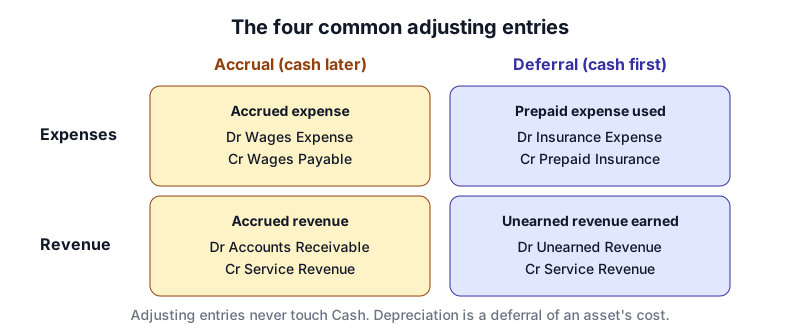
Memo 1. Policy receipt dated January 1 shows a $3,000 premium for January through December. One month used: $3,000 ÷ 12 = $250. Recorded as a prepaid expense when paid, so June's share moves to expense.
Memo 2. Timesheets for June 26 to 30 show $720 of wages earned and unpaid at June 30. Payday is July 7. The cost belongs in June, so it is accrued.
| Account | Debit | Credit |
|---|---|---|
| June 30: one month of prepaid insurance used | ||
| Insurance Expense | $250.00 | |
| Prepaid Insurance | $250.00 | |
| June 30: accrue wages earned but unpaid | ||
| Wages Expense | $720.00 | |
| Wages Payable | $720.00 | |
Neither entry touches Cash, which a reviewer will notice and expect. Both follow the patterns in the adjusting entries cheat sheet.
Show the support behind the numbers
Real books rest on documents, and your portfolio should too. IRS Publication 583 describes the supporting documents a business keeps. They include records of gross receipts, such as invoices and deposit slips, and records of purchases and expenses, such as canceled checks and account statements. Asset records, such as purchase invoices, belong there too. Include the fictional version of each document next to the entry it supports, so a reviewer can trace any number back to its source.
A sample cover page
The cover page is what a reviewer reads first, and often the only page they read closely. Keep it to the facts a supervisor would want before opening the binder. Here is a fictional example:
| Item | Detail |
|---|---|
| Business | Fictional office-cleaning company, sole proprietor |
| Period | June, one month |
| Basis | Accrual |
| Work done | 42 transactions recorded from source documents; bank account reconciled; 4 adjusting entries; statements prepared; period closed |
| Checks performed | Adjusted bank and book balances agree; adjusted trial balance debits equal credits; subledgers agree with control accounts |
| Result | Net income for June, with the income statement and balance sheet attached |
| Data | All names and figures are invented |
The "checks performed" row matters most. It tells the reviewer you know how to prove your own work, which is the habit employers are hiring for.
Common portfolio mistakes
A few problems make otherwise good work hard to trust:
- Unfinished projects. A reconciliation that doesn't reconcile, or a trial balance that doesn't balance, undoes the point. Finish fewer projects completely.
- No working shown. Final statements alone don't prove you built them. Include the journal, the reconciliation and the memos.
- Inconsistent account names. Use one chart of accounts per project and stick to it, so "Rent expense" never appears as "Rent" in one place and "Office rent" in another.
- Copied answer keys. If a project came with a solution, redo it from the documents without looking. A reviewer may ask you to explain any line.
- Too much at once. A single folder of fifty files is hard to review. One index page and a handful of projects is enough.
Keep it fictional and safe
Use invented businesses, names and figures, and say so on each cover page. Never include a real client's or employer's records, even with names removed. Handling confidential data carefully is part of the job, and a portfolio is a test of judgment as much as skill.
How to present it to employers
A portfolio only works if someone looks at it. Make that easy.
- Lead with a one-page index. List each project, the business type and the skills it shows, with a link or page number.
- Use simple formats. A PDF for the summary and statements, and a spreadsheet for the reconciliation and trial balance, open in most tools.
- Mention it on your résumé. One line under a Projects heading: "Month-end close for a fictional cleaning business: reconciliation, adjusting entries, statements."
- Prepare to walk through it. In an interview, be ready to explain one entry and one reconciling item in your own words. The bookkeeper interview questions and the interview preparation lesson help you rehearse.
Spreadsheet skills make the portfolio cleaner and faster to build. The sibling post on Excel skills every bookkeeper needs covers the reconciliation sheet and pivot-table trial balance in detail, and how to become a bookkeeper places the portfolio in a wider plan.
Frequently asked questions
How many projects should a bookkeeping portfolio have?
Three to five finished projects is enough. One fully documented month-end close is worth more than many half-finished exercises.
Can I use practice projects instead of work experience?
They don't replace experience, but they show an employer what you can do before anyone hires you. Pair them with any related work, such as handling cash or invoices in another job.
Should I include a certification in my portfolio?
If you have one, list it on the index page. The sibling post on bookkeeping certifications compared covers the main options.
What to practice next
Build your first portfolio piece from graded work so you know the numbers are right. Start with adjusting entries practice and bank reconciliation exercises, then take on the graded month-end close capstone and document it using the binder layout above. Mixed bookkeeping practice keeps every skill fresh in between.
Sources
- Bookkeeping, Accounting, and Auditing Clerks (Occupational Outlook Handbook) — U.S. Bureau of Labor Statistics
- Publication 583: Starting a Business and Keeping Records — IRS
- The Certified Bookkeeper (CB) Designation: Student Handbook for Self-Study CB Exam Prep — American Institute of Professional Bookkeepers (AIPB)
Educational content for US small-business bookkeeping, not tax, legal or accounting advice. Example businesses and figures are fictional. See our editorial policy for how we write and correct content.