Bookkeeping careers
Bookkeeper vs accountant: what each one does
How bookkeepers and accountants split the work, with BLS pay and outlook figures, education and CPA licensing, and when a small business needs each.
By TNas · · 7 min read
A bookkeeper records a business's financial transactions and keeps the books accurate day to day. An accountant uses those records to prepare adjusted financial statements, file taxes, check for errors and advise on decisions. The two roles overlap in the middle, but the short version is: the bookkeeper builds the record, and the accountant reviews and interprets it.
The roles also differ in education, licensing and pay. This post compares them side by side using U.S. Bureau of Labor Statistics (BLS) data, then shows where one job hands off to the other with a worked example.
The short answer in a table
| Bookkeeper | Accountant | |
|---|---|---|
| Main job | Record, classify and reconcile transactions | Review, adjust, report, file taxes, advise |
| Typical entry education (BLS) | Some college, no degree | Bachelor's degree in accounting or a related field |
| Training | Moderate-term on-the-job training | Degree, often followed by licensing |
| Required license | None | None for many roles; a CPA license for some work |
| Median pay, May 2025 (BLS) | $50,670 | $83,680 |
| Projected employment, 2025 to 2035 (BLS) | Down 6% | Up 5% |
| When a small business uses it | Every week or month | Year-end, tax time, big decisions |
The BLS groups bookkeepers with accounting and auditing clerks, so the bookkeeper figures cover that wider group. The sections below explain each row.
What a bookkeeper does
A bookkeeper is the person who turns source documents (invoices, receipts, bank statements) into journal entries and keeps the ledger in balance. The BLS Occupational Outlook Handbook lists these core duties for bookkeeping, accounting and auditing clerks:
- use bookkeeping software, spreadsheets and databases
- post financial transactions and record cash, checks and vouchers
- produce reports such as balance sheets, income statements and totals by account
- check figures, postings and reports for accuracy
- reconcile records and report any differences
The BLS also describes full-charge bookkeeping clerks, who maintain an entire organization's books. In a small business that often means the bookkeeper handles invoicing, bills, payroll records and the monthly bank reconciliation.
A typical bookkeeper's month looks like this:
- Record sales invoices and customer payments.
- Enter supplier bills and record payments.
- Categorize bank and card transactions to the right account.
- Reconcile each bank and credit card account to its statement.
- Run a trial balance and fix anything that looks wrong.
This is the work the journal entries learning module and the bank reconciliation module train.
What an accountant does
An accountant prepares and examines financial records with a wider brief. The BLS profile of accountants and auditors lists duties that include:
- checking that financial statements are accurate and follow laws and regulations
- computing, preparing and filing taxes
- reviewing accounting systems for efficiency and fraud risk
- organizing and analyzing financial records
- recommending ways to cut costs, raise revenue and improve profits
In a small business, the accountant usually steps in at a few points:
- reviewing the books at year-end and proposing adjusting entries
- preparing financial statements a lender or investor will read
- preparing or reviewing tax returns
- advising on structure, budgeting and big purchases
Where the work hands off: a worked example
The line between the jobs is easiest to see in the entries each one makes. Take a fictional design studio in its March books.
The bookkeeper records the month's transactions as they happen. A finished project is invoiced, and the client pays part of an older invoice:
| Account | Debit | Credit |
|---|---|---|
| March 20: invoice a client for finished work | ||
| Accounts Receivable | $2,400.00 | |
| Service Revenue | $2,400.00 | |
| March 24: client pays an earlier invoice | ||
| Cash | $1,500.00 | |
| Accounts Receivable | $1,500.00 | |
At month-end or year-end, an accountant reviews the books and proposes adjustments the daily records don't capture. The studio owns a computer that cost $3,600 with no salvage value and a 3-year useful life. Using straight-line depreciation, that is $3,600 ÷ 36 months = $100 a month:
| Account | Debit | Credit |
|---|---|---|
| March 31: record a month of depreciation | ||
| Depreciation Expense | $100.00 | |
| Accumulated Depreciation | $100.00 | |
In practice the line moves. A full-charge bookkeeper often records depreciation and other routine adjustments too, and many accountants still post daily entries in a small firm. What differs is responsibility: the accountant is usually the one who decides how an unusual item should be treated and signs off on the statements. The adjusting entries lesson explains why these month-end entries exist.
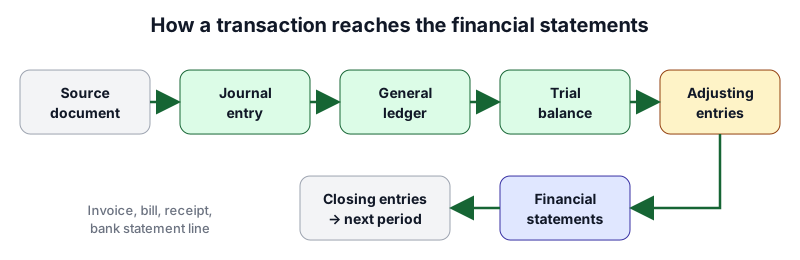
In the cycle above, the bookkeeper usually owns the steps from source documents to the unadjusted trial balance. The accountant does more of the work from adjustments through the statements and tax return.
Education and licensing
Bookkeepers
The BLS lists the typical entry-level education for bookkeeping, accounting and auditing clerks as some college, no degree, with moderate-term on-the-job training. It notes that employers generally prefer a high school diploma plus some college courses in related subjects. Certification is "not usually required," though some clerks earn one to show competency. The sibling post on bookkeeping certifications compared covers the main options.
Accountants and CPAs
Accountants typically need a bachelor's degree in accounting or a related field, according to the BLS. A certified public accountant (CPA) is an accountant licensed by a state board of accountancy. NASBA is the national association of those boards. Its licensure overview explains that becoming a CPA means passing the Uniform CPA Exam and meeting the licensing rules of the state where you plan to practice. Those rules include education and experience requirements. The BLS adds that accountants who file reports with the Securities and Exchange Commission must be licensed CPAs.
Not every accountant is a CPA. Many accounting jobs don't require the license, so check what a specific role or service requires before assuming you need it.
Pay and job outlook
The BLS reports these figures for May 2025 and its 2025 to 2035 projections:
| Measure | Bookkeeping, accounting and auditing clerks | Accountants and auditors |
|---|---|---|
| Median annual wage | $50,670 ($24.36 an hour) | $83,680 ($40.23 an hour) |
| Jobs in 2025 | About 1,532,400 | About 1,595,200 |
| Projected change, 2025 to 2035 | Decline of 6% | Growth of 5% |
| Openings each year, on average | About 144,100 | About 115,300 |
A median means half the workers earned more and half earned less, so your own pay will depend on location, experience and employer. The decline for clerks doesn't mean the work disappears: the BLS projects about 144,100 openings a year, all from replacing workers who move to other jobs or leave the labor force. The sibling post is bookkeeping a good career? looks at those numbers in more depth.
Does a small business need a bookkeeper, an accountant or both?
Every business needs records. The IRS says plainly that "everyone in business must keep records," and those records back up what you report on your return (IRS Publication 583). Who keeps them is the real question.
| Situation | Usually enough | Why |
|---|---|---|
| Few transactions, owner comfortable with the books | Owner plus an accountant at tax time | The owner keeps records; the accountant reviews and files |
| Regular invoicing, bills, payroll | A bookkeeper monthly, an accountant yearly | Daily accuracy plus an annual review and tax return |
| Applying for a loan or bringing in investors | Both, with the accountant preparing statements | Outsiders expect reviewed financial statements |
| Unusual items (a large asset sale, a new entity) | An accountant before the transaction | Treatment and tax effects need judgment |
This is bookkeeping guidance, not tax or legal advice. For tax treatment in your situation, ask a tax professional.
Moving from bookkeeper to accountant
Many people start in bookkeeping and move into accounting. The skills carry over directly: an accountant who has kept books knows where errors hide and how the ledger is built. The usual steps are:
- Master the full cycle through the adjusted trial balance and financial statements.
- Take accounting coursework toward a degree if you want accountant roles that require one.
- If you want to be a CPA, check your state board's education and experience rules early.
Frequently asked questions
Can a bookkeeper do taxes?
Bookkeepers often prepare the records an accountant or tax preparer uses. Preparing returns for pay brings separate rules. The IRS says anyone who prepares or assists in preparing federal tax returns for compensation must have a valid preparer tax identification number (IRS PTIN requirements). Check those rules before offering tax work.
Is an accountant the same as a CPA?
No. A CPA is an accountant who has passed the Uniform CPA Exam and holds a license from a state board of accountancy. Many accountants work without that license.
Which pays more?
BLS data show a higher median wage for accountants and auditors ($83,680) than for bookkeeping, accounting and auditing clerks ($50,670) in May 2025. Individual pay varies widely.
What to practice next
Bookkeeping is the foundation of both jobs, and it is learned by doing. Start with journal entry practice to make daily recording automatic. Then move to adjusting entries practice, where bookkeeping meets accounting, and finish with financial statement classification.
Sources
- Bookkeeping, Accounting, and Auditing Clerks (Occupational Outlook Handbook) — U.S. Bureau of Labor Statistics
- Accountants and Auditors (Occupational Outlook Handbook) — U.S. Bureau of Labor Statistics
- Licensure — National Association of State Boards of Accountancy (NASBA)
- Publication 583: Starting a Business and Keeping Records — IRS
- PTIN Requirements for Tax Return Preparers — IRS
Educational content for US small-business bookkeeping, not tax, legal or accounting advice. Example businesses and figures are fictional. See our editorial policy for how we write and correct content.