Recording transactions
How to record annual software subscriptions
Record monthly and annual software plans correctly, with a prepaid expense schedule, monthly adjusting entries, upgrades, refunds and a small-item policy.
By TNas · · 7 min read
Record an annual software subscription paid upfront as a prepaid expense: debit Prepaid software and credit Cash (or Accounts payable) for the full amount, then move one month's share to Software expense at each month-end. A monthly plan needs none of this; it is expensed when billed. The only judgment call is whether a small annual plan is worth spreading at all, which a written policy settles.
The business and figures below are fictional and used only to show the entries.
Monthly plan or annual plan: what changes in the books
The accounting follows when the business gets the benefit, not when it pays. That is expense recognition: an expense belongs to the period that uses the resource.
| Monthly billing | Annual billing paid upfront | |
|---|---|---|
| What you pay | One month at a time | Twelve months at once |
| Entry when billed | Debit Software expense, credit Cash | Debit Prepaid software, credit Cash |
| Month-end adjustment | None | Debit Software expense, credit Prepaid software |
| Balance sheet effect | None | Prepaid software shrinks each month |
| Income statement effect | Same each month | Same each month, once the adjustment is posted |
Both columns end up with the same monthly expense. The difference is that the annual plan sits on the balance sheet first.
Recording a monthly subscription
Fictional Harbor Consulting pays $49 a month for a scheduling tool, charged on the 1st:
| Account | Debit | Credit |
|---|---|---|
| May 1: monthly scheduling tool subscription | ||
| Software Expense | $49.00 | |
| Cash | $49.00 | |
The service is used up in May, so May carries the cost. No adjusting entry is needed. If the charge goes on a business credit card, credit the card liability instead of Cash.
Recording an annual subscription paid upfront
On April 1, Harbor Consulting pays $2,400 for a 12-month project management plan running April 1 through March 31.
A prepaid expense is a cost paid before the business uses what it bought. It is an asset because the business still has 12 months of service coming. OpenStax describes prepaid expenses the same way: assets created by paying in advance, moved to the income statement as they are used (OpenStax, Principles of Accounting).
| Account | Debit | Credit |
|---|---|---|
| April 1: pay the annual plan | ||
| Prepaid Software | $2,400.00 | |
| Cash | $2,400.00 | |
If the vendor sends an invoice with 30-day terms instead of charging a card, credit Accounts payable now and record the payment later. The prepaid asset starts on the date the service period begins.
The monthly adjusting entry
Each month uses $2,400 ÷ 12 = $200 of the plan. At every month-end, an adjusting entry moves that share to expense:
| Account | Debit | Credit |
|---|---|---|
| April 30: one month of the annual plan used | ||
| Software Expense | $200.00 | |
| Prepaid Software | $200.00 | |
The same $200 entry repeats on the last day of each month through March 31. Notice that Cash isn't in it. Adjusting entries move amounts between balance sheet and income statement accounts; the cash left the business on April 1. The deferrals lesson walks through the same mechanics with prepaid insurance and rent.
The amortization schedule
A schedule shows the opening balance, the monthly expense and the remaining prepaid balance. Its last line should reach exactly zero.
| Month-end | Expense this month | Prepaid software balance |
|---|---|---|
| April 30 | $200.00 | $2,200.00 |
| May 31 | $200.00 | $2,000.00 |
| June 30 | $200.00 | $1,800.00 |
| July 31 | $200.00 | $1,600.00 |
| August 31 | $200.00 | $1,400.00 |
| September 30 | $200.00 | $1,200.00 |
| October 31 | $200.00 | $1,000.00 |
| November 30 | $200.00 | $800.00 |
| December 31 | $200.00 | $600.00 |
| January 31 | $200.00 | $400.00 |
| February 28 | $200.00 | $200.00 |
| March 31 | $200.00 | $0.00 |
| Total | $2,400.00 |
At each month-end, the Prepaid software balance in the general ledger should equal the schedule's balance. If several subscriptions share one Prepaid software account, the schedule lists each one and the total of the remaining balances must agree to the ledger.
When the amount doesn't divide evenly
A $1,000 annual plan works out to $83.333 a month. Round to cents with a stated rule so the total is exact. One common rule, and the one this site's exercises use, puts the extra cents in the earliest months: $1,000.00 is 100,000 cents, and 100,000 ÷ 12 = 8,333 cents with 4 left over. The first four months are $83.34 and the remaining eight are $83.33.
Check: 4 × $83.34 = $333.36, plus 8 × $83.33 = $666.64, totals $1,000.00.
Small subscriptions and a capitalization policy
Spreading a $120 annual plan over 12 entries of $10 is accurate, but it adds work that rarely changes any decision. Many businesses set a written policy: annual subscriptions under a set amount are expensed immediately.
| Account | Debit | Credit |
|---|---|---|
| June 1: small annual plan expensed under the written policy | ||
| Software Expense | $120.00 | |
| Cash | $120.00 | |
This is a materiality judgment. An amount is material if leaving it out or misplacing it could change what a reader of the statements concludes. A few rules keep the policy defensible:
- Write the threshold down and apply it to every subscription, every year.
- Look at the total, not just each item. Twenty small annual plans renewing in the same month can distort that month even if each is small.
- Note the policy in the entry description, so a reviewer can see why the item was expensed.
The site's capitalizing fixed assets lesson uses the same idea for small equipment purchases.
Tax rules are separate from your book policy. IRS Publication 538 explains that an expense paid in advance is generally deductible only in the year to which it applies (IRS Publication 538). It also describes a 12-month rule for certain prepaid benefits that don't extend beyond the earlier of 12 months after the benefit begins or the end of the following tax year. Publication 538 also says IRS approval may be needed before using those rules if you haven't applied them before. Ask a tax professional how they apply to your return; the books can still spread the cost monthly.
Upgrades, renewals and refunds
Adding seats partway through the term
On August 1, Harbor Consulting adds users and pays a prorated $300 for the remaining eight months of the term (August through March):
| Account | Debit | Credit |
|---|---|---|
| August 1: prorated charge for added seats | ||
| Prepaid Software | $300.00 | |
| Cash | $300.00 | |
From August, the monthly expense becomes $200 + ($300 ÷ 8) = $200 + $37.50 = $237.50. Add a separate line to the schedule for the upgrade, so each charge runs out on the right date.
Renewing early
If the renewal for the next year is paid on March 15, debit Prepaid software for the new term. None of it is expensed in March, because the new service period starts April 1. Keep the renewal on a new schedule line so the two terms don't mix.
Cancelling with a refund
Now take the original plan on its own, without the upgrade. Suppose Harbor cancels at the end of September and the vendor refunds the unused six months of the original plan (October through March), $1,200. After the September 30 adjustment, the original plan's Prepaid software balance is exactly $1,200:
| Account | Debit | Credit |
|---|---|---|
| October 5: refund of the unused months | ||
| Cash | $1,200.00 | |
| Prepaid Software | $1,200.00 | |
If a vendor refunds less than the remaining balance, the leftover prepaid amount is expensed, because the business will get no more service for it.
The refund lands in the bank as a deposit with the vendor's name. Match it during the bank reconciliation to the Prepaid software account, not to revenue.
Where the subscription shows up in the statements
On Harbor Consulting's June 30 balance sheet, Prepaid software shows $1,800.00 as a current asset, because all of it will be used within the next 12 months. On the income statement for April through June, Software expense shows $600.00 for the annual plan, plus $147.00 for three months of the $49 scheduling tool.
A plan longer than a year, such as a 36-month contract paid upfront, works the same way with a longer schedule. The portion that will be used in the next 12 months is usually shown as current and the rest as a non-current asset.
Software expense is the income statement account for subscriptions used in the period. Some businesses split it further, for example into separate accounts for design tools and accounting tools, so owners can see where the money goes. Keep the split simple enough that every charge has an obvious home.
Common mistakes with software subscriptions
- Expensing a large annual plan in the month paid. The payment month looks expensive and the next 11 months look cheaper than they are.
- Forgetting the monthly adjustment. The prepaid balance stays high and expenses are understated. A recurring journal entry or a month-end checklist prevents this.
- Treating software as equipment. A subscription gives access for a period; it is a prepaid expense, not a fixed asset with depreciation.
- Starting the schedule on the payment date instead of the service date. If you pay on March 20 for a term that starts April 1, March gets no expense.
- No schedule. Without one, nobody can prove the Prepaid software balance is right.
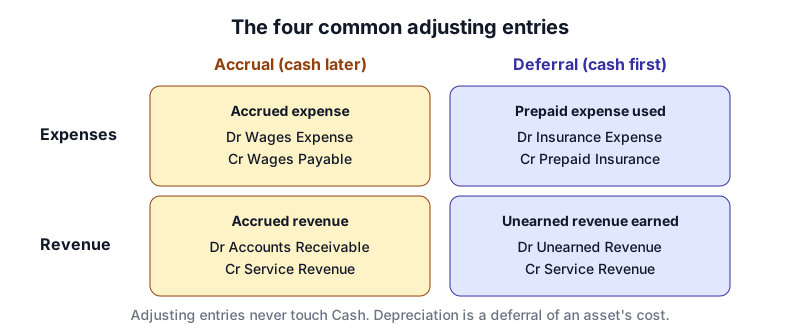
The planned post on prepaid insurance month by month applies this same schedule to insurance policies, and the adjusting entries cheat sheet covers the other three adjustment types.
What to practice next
Prepaid subscriptions are a deferral, one of the four adjusting entries every bookkeeper uses at month-end. Practice recording the upfront payment and the monthly adjustment in the adjusting entries practice set, then test the timing logic with the cash vs accrual basis exercises.
Sources
- Publication 538, Accounting Periods and Methods — IRS
- Principles of Accounting, Volume 1: 4.2 Discuss the Adjustment Process and Illustrate Common Types of Adjusting Entries — OpenStax
Educational content for US small-business bookkeeping, not tax, legal or accounting advice. Example businesses and figures are fictional. See our editorial policy for how we write and correct content.