Recording transactions
How to record prepaid insurance month by month
Record an annual insurance premium as Prepaid insurance, build a 12-month schedule, post the monthly adjusting entry, and handle cents and cancellations.
By TNas · · 7 min read
Record an annual insurance premium as an asset, Prepaid insurance, on the day you pay it. Then, at the end of each month the policy covers, make an adjusting entry that debits Insurance expense and credits Prepaid insurance for one month's share. For a $3,600 twelve-month policy that's $300 a month, and after twelve entries the prepaid balance is zero.
The example uses a fictional company, Harbor Point Landscaping, and invented amounts.
Why prepaid insurance is an asset
Prepaid insurance is an asset that represents coverage you've paid for but haven't used yet. If Harbor Point cancelled on day one, the unused premium would have value: most or all of it would come back. That future benefit is what makes it an asset rather than an expense.
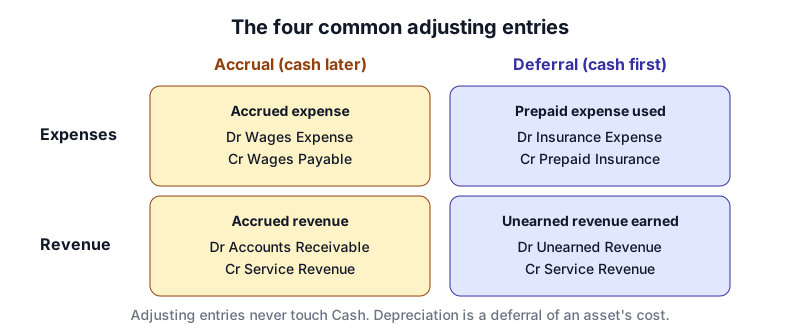
A prepaid expense is a cost paid before the benefit is received, such as rent, insurance or an annual subscription (glossary). Adjusting one is a deferral: the cost is deferred on the balance sheet and recognized as the coverage is used up. OpenStax describes prepaid insurance the same way, as an asset where payment happens "before the company can benefit from use," in its section on adjusting entries.
Spreading the cost matches each month's insurance expense to the month the coverage protected the business. That's the matching principle at work, and it's why accrual-basis books don't expense the full premium when it's paid.
Step 1: record the premium payment
On March 1, 2026, Harbor Point pays $3,600 for a general liability policy covering March 1, 2026 through February 28, 2027.
| Account | Debit | Credit |
|---|---|---|
| March 1: pay the 12-month premium | ||
| Prepaid Insurance | $3,600.00 | |
| Cash | $3,600.00 | |
One asset goes up and another goes down. No expense yet, so this entry doesn't affect profit. Keep the policy declarations page with the payment: it's the source document that proves the coverage dates and amount.
Step 2: build the amortization schedule
Divide the premium by the months covered: $3,600 ÷ 12 = $300 per month. Then lay out every month before you post anything. The schedule is your plan for twelve adjusting entries and your check that the balance will reach zero.
| Month-end | Expense this month | Expense to date | Prepaid balance |
|---|---|---|---|
| Mar 31, 2026 | 300.00 | 300.00 | 3,300.00 |
| Apr 30, 2026 | 300.00 | 600.00 | 3,000.00 |
| May 31, 2026 | 300.00 | 900.00 | 2,700.00 |
| Jun 30, 2026 | 300.00 | 1,200.00 | 2,400.00 |
| Jul 31, 2026 | 300.00 | 1,500.00 | 2,100.00 |
| Aug 31, 2026 | 300.00 | 1,800.00 | 1,800.00 |
| Sep 30, 2026 | 300.00 | 2,100.00 | 1,500.00 |
| Oct 31, 2026 | 300.00 | 2,400.00 | 1,200.00 |
| Nov 30, 2026 | 300.00 | 2,700.00 | 900.00 |
| Dec 31, 2026 | 300.00 | 3,000.00 | 600.00 |
| Jan 31, 2027 | 300.00 | 3,300.00 | 300.00 |
| Feb 28, 2027 | 300.00 | 3,600.00 | 0.00 |
Notice the December row. Harbor Point's fiscal year ends December 31, so ten months ($3,000) belong to 2026 and two months ($600) remain as an asset on the 2026 balance sheet. Those two months will become 2027 expense.
Step 3: post the monthly adjusting entry
At each month-end, record one month of coverage used:
| Account | Debit | Credit |
|---|---|---|
| March 31: one month of coverage used | ||
| Insurance Expense | $300.00 | |
| Prepaid Insurance | $300.00 | |
The same entry repeats every month through February 2027. Two things to notice:
- Cash doesn't appear. The cash left in March. An adjusting entry only reallocates an amount already recorded, which is why the adjusting entries overview warns against crediting Cash in an adjustment.
- The entry is identical each month. Most accounting software lets you set it up as a recurring journal entry. Even so, compare the Prepaid insurance balance to the schedule's last column at every close.
When the premium doesn't divide evenly
Real premiums rarely divide into round numbers. For example, say a policy costs $2,500 for twelve months. $2,500 ÷ 12 = $208.333..., which rounds to $208.33. But $208.33 × 12 = $2,499.96, leaving 4 cents stranded in Prepaid insurance forever.
Fix it in the schedule, not at the end. This site's convention, from the straight-line depreciation lesson, is to put the extra cents in the earliest months:
| Months | Monthly expense | Total |
|---|---|---|
| Months 1 to 4 | 208.34 | 833.36 |
| Months 5 to 12 | 208.33 | 1,666.64 |
| Policy total | 2,500.00 |
Any consistent rule works (some bookkeepers put the difference in the final month). What matters is that the schedule totals the premium exactly and the last entry leaves a zero balance.
Policies that start mid-month
Consider a policy that runs from March 15 to March 14 of the next year. You can allocate by days, or treat the policy as starting in the month it begins and use whole months. Whole months are simpler and usually immaterial for a small business. Whichever you choose, write it down and apply it to every policy.
The expense-first method and its year-end adjustment
Some businesses record every insurance payment straight to Insurance expense and fix the balance at year-end. That works if you remember the adjustment.
Under that method, Harbor Point would have debited Insurance expense $3,600 on March 1. At December 31, the schedule shows $600 of coverage still unused, so the year-end entry moves it back to the asset:
| Account | Debit | Credit |
|---|---|---|
| December 31: move unused coverage back to the asset | ||
| Prepaid Insurance | $600.00 | |
| Insurance Expense | $600.00 | |
Year-end results are the same under both methods: $3,000 of 2026 expense and $600 of prepaid asset. The difference is monthly. Expense-first overstates expense in March and understates it in every month after, so monthly profit reports are lumpy. If you review results monthly, record the prepaid asset from the start.
When a policy is cancelled early
Suppose Harbor Point sells part of its equipment fleet and cancels the policy after five months. The schedule shows $2,100 still in Prepaid insurance (seven unused months). The insurer refunds $1,900 and keeps $200 as a cancellation charge.
| Account | Debit | Credit |
|---|---|---|
| August 1: policy cancelled, partial refund received | ||
| Cash | $1,900.00 | |
| Insurance Expense | $200.00 | |
| Prepaid Insurance | $2,100.00 | |
The whole remaining balance comes off the books. The $200 the insurer kept is a cost of the coverage, so it goes to Insurance expense. If the refund arrives later than the cancellation date, debit a receivable from the insurer instead of Cash, then clear it when the check comes in.
Book timing vs tax timing
Your books follow the monthly schedule. Your tax deduction may not. IRS Publication 538 explains that an expense paid in advance is generally deductible only in the year it applies to. It then describes a 12-month rule for benefits that don't extend beyond the earlier of 12 months after the benefit begins or the end of the following tax year. Its example of a three-year, $3,000 policy paid in 2021 allows only "$500 (6/36 x $3,000)" in the first year.
On a sole proprietor's return, the IRS Schedule C instructions tell filers to deduct premiums paid for business insurance on line 15. Whether a policy like Harbor Point's qualifies for the 12-month rule, and how to apply it, is a question for a tax professional. The bookkeeping above doesn't change either way.
Common prepaid insurance mistakes
| Mistake | Effect | Fix |
|---|---|---|
| Expensing the annual premium in the month paid and never adjusting | Expense too high this year, asset missing | Record Prepaid insurance, or adjust at year-end |
| Crediting Cash in the monthly adjustment | Cash understated, payment recorded twice | Credit Prepaid insurance |
| Forgetting a month | Prepaid balance doesn't match the schedule | Compare ledger to schedule at every close |
| Leaving rounding cents in the account | A small balance lingers after the policy ends | Build the cents into the schedule |
| Booking a renewal over an unexpired balance without a new schedule | Two policies blur together | Keep one schedule per policy period |
Frequently asked questions
Is prepaid insurance a current asset?
Usually, yes. A policy of twelve months or less will be used up within a year, so the whole balance is current. For a multi-year policy, the part covering the next twelve months is current and the rest is long-term.
What if I pay the premium in monthly installments?
Then there's nothing to defer. Each monthly payment covers that month's coverage, so debit Insurance expense and credit Cash when you pay. Prepaid insurance only arises when you pay ahead of the coverage period.
Do I need a schedule for every policy?
Yes, one per policy period. General liability, property and vehicle policies often renew on different dates, and a separate schedule for each keeps the Prepaid insurance balance easy to prove at month-end.
What to practice next
Prepaid insurance is the classic first deferral. Practice the monthly entry and its variations (rent, subscriptions, supplies counts) in adjusting entries practice, and see how the expense-first and asset-first methods compare in cash vs accrual practice. The adjusting entries cheat sheet keeps all four adjustment types on one page, and the planned post on annual software subscriptions applies the same schedule to software plans.
Sources
- 4.2 Discuss the Adjustment Process and Illustrate Common Types of Adjusting Entries — OpenStax, Principles of Accounting, Volume 1
- Publication 538 (01/2022), Accounting Periods and Methods — IRS
- 2025 Instructions for Schedule C (Form 1040) — IRS
Educational content for US small-business bookkeeping, not tax, legal or accounting advice. Example businesses and figures are fictional. See our editorial policy for how we write and correct content.