Cleanup and reconciliation
Why your balance sheet doesn't balance and how to fix it
Find why assets don't equal liabilities plus equity, using the size of the difference, a step-by-step search and the entries that fix each cause.
By TNas · · 8 min read
A balance sheet fails to balance when something broke double-entry: an entry posted on one side only, a balance copied onto the report wrong, or equity missing the current year's net income. Measure the difference between total assets and total liabilities plus equity, then use its size to narrow the search. Most problems are found in minutes once you know what the number is telling you.
Why a balance sheet has to balance
The balance sheet is the accounting equation written out in full: assets = liabilities + equity. Every transaction recorded with double-entry bookkeeping keeps that equation true, because each entry has equal debits and credits. If every entry balances and every balance reaches the report correctly, the two sides must agree.
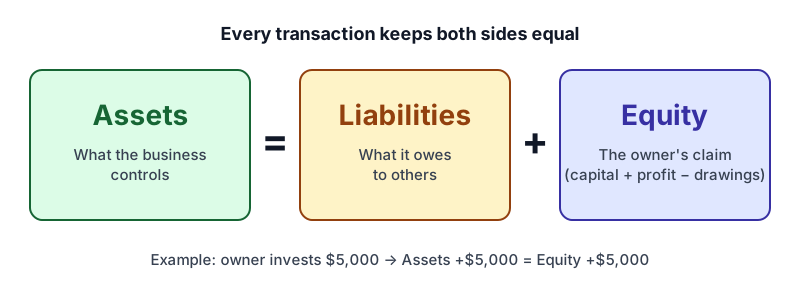
So an imbalance always means one of three things happened:
- An entry was recorded with unequal debits and credits, or on one side only.
- A ledger balance was carried to the trial balance or the report incorrectly.
- Part of equity is missing from the report, usually the current year's profit or the owner's drawings.
Accounting software normally refuses entries that don't balance, so true imbalances show up mostly in spreadsheets, hand-kept books and data imports. In software, the more common symptom is a balance sheet that does balance but carries a strange plug account. Both are covered below.
Common causes, from most to least likely
Current-year net income left out of equity
During the year, revenue and expense accounts haven't been closed yet. Their net result, net income, belongs in equity until the closing entries move it to owner's capital. A spreadsheet balance sheet that lists only last year's owner's capital will be off by exactly the year's profit or loss. The statement of owner's equity lesson shows how net income flows into equity.
A single-sided or unequal entry
In a hand-built ledger it is easy to record the debit and forget the credit. An equipment purchase on account entered only as a debit to Equipment overstates assets by the full amount, with nothing on the other side.
A balance placed on the wrong side
A debit-balance account listed in the credit column (or the reverse) moves the totals apart by twice its amount. OpenStax's trial balance chapter uses exactly this example: a balance listed in the wrong column creates a difference of double its value.
A transposition or slide
A transposition error is two digits swapped, such as 4,710 typed as 4,170. A slide is a misplaced decimal point, such as 500 typed as 50. Both create a difference divisible by 9. See the glossary entry on transposition errors.
Imports and opening balances
Importing a bank file or a list of open invoices can create one-sided postings if the import maps only one account. Entering opening balances one account at a time can do the same unless every balance has an offset.
Step-by-step: how to find the difference
Work through these steps in order. Each one rules out a whole group of causes.
- Check the report settings. Confirm the balance sheet date and the basis (accrual or cash). Compare to a report you know is right.
- Measure the difference. Subtract the smaller side from the larger. Write the number down and note which side is larger.
- Run the trial balance. If the trial balance debits and credits also differ by the same amount, the problem is in the ledger. If the trial balance balances, the problem is in how the balance sheet was built from it.
- Compare the difference to net income. If they match, equity is missing the current year's profit.
- Search for the amount itself. Look for an entry or balance equal to the difference. A match suggests a missing side.
- Divide by 2. Look for a balance equal to half the difference on the larger side. A match suggests a balance on the wrong side.
- Divide by 9. A whole-number result suggests a transposition or slide. Compare each balance to its ledger, digit by digit.
- Trace the ledger. If none of the tests find it, re-foot each account and trace postings back to the journal. OpenStax recommends this last resort: go back one step at a time.
The finding trial-balance differences lesson teaches these tests with drills, and the trial balance errors guide has more examples.
The difference tells you where to look
| Difference equals | Most likely cause |
|---|---|
| Current-year net income or loss | Profit not added to equity |
| Total owner's drawings | Drawings not subtracted from equity |
| One transaction amount | One side of an entry missing |
| Twice an amount | A balance on the wrong side |
| A multiple of 9 | Transposed digits or a slide |
| A small round amount | Rounding or an import that dropped cents |
A worked example: Riverside Print Shop
Riverside Print Shop is a fictional sole proprietorship. Its owner built a June 30 balance sheet in a spreadsheet from the ledger.
| Assets | Amount | Liabilities and equity | Amount |
|---|---|---|---|
| Cash | 9,640.00 | Accounts payable | 2,150.00 |
| Accounts receivable | 4,170.00 | Unearned revenue | 870.00 |
| Supplies | 380.00 | Notes payable | 6,000.00 |
| Equipment | 18,500.00 | Owner Capital, January 1 | 16,800.00 |
| Accumulated depreciation | (3,700.00) | Net income, January to June | 4,960.00 |
| Owner Drawings | (1,250.00) | ||
| Total assets | 28,990.00 | Total liabilities and equity | 29,530.00 |
Find the difference
Liabilities and equity exceed assets by $29,530 − $28,990 = $540. The trial balance from the ledger balances, so the ledger is fine and the error is on the report.
Run the tests
- Net income is $4,960, not $540, so equity isn't missing profit.
- No single balance or entry is $540.
- Half the difference is $270. No balance is $270.
- $540 ÷ 9 = 60, a whole number. That suggests transposed digits.
Comparing each line to the ledger shows Accounts receivable is $4,710 in the ledger but $4,170 on the report. The hundreds and tens digits were swapped: $4,710 − $4,170 = $540.
Fix it
Correct the report, not the books. With receivables at $4,710, total assets become $29,530 and the balance sheet balances. No journal entry is needed, because the ledger was right.
When the fix is a journal entry
If the error is in the ledger, you need a correcting entry. Every correcting entry must itself balance, so you can't fix a one-sided posting with another one-sided posting. Instead, reverse the bad posting, then record the transaction properly.
Suppose a fictional $1,250 printer bought on account was posted in a spreadsheet ledger only as a debit to Equipment. Remove the one-sided line from the ledger, then record the full entry:
| Account | Debit | Credit |
|---|---|---|
| Record the printer purchase with both sides | ||
| Equipment | $1,250.00 | |
| Accounts Payable | $1,250.00 | |
Some ledger errors keep the books in balance but still need an entry. If a whole entry was recorded backward (a customer payment entered as Dr Accounts receivable, Cr Cash instead of the reverse), the fix is twice the amount. One half undoes the wrong posting and the other half records the right one. For a fictional $600 payment:
| Account | Debit | Credit |
|---|---|---|
| Correct a customer payment posted to the wrong side of receivables | ||
| Cash | $1,200.00 | |
| Accounts Receivable | $1,200.00 | |
Always check what was actually posted before writing the correction, because the right fix depends on it.
Opening balance equity: balanced but not right
Many accounting programs post an automatic offset to an account called Opening balance equity when you enter a starting balance without a matching entry. The balance sheet then balances, but the offset is a placeholder. After setup is complete, its balance should be zero.
If Opening balance equity still has a balance, find out where it came from. Run the account's ledger detail. Each line points to an opening balance or a transaction entered without a proper offset. Usually it is one of these:
- Starting balances for the bank, loans or fixed assets, which belong in owner's capital once all are entered.
- An opening bank balance that didn't match the reconciled balance.
- Open invoices or bills entered without their totals agreeing to the receivables or payables balance.
When you have checked that every opening balance agrees to the prior records, move what's left to owner's capital. For a fictional $3,400 remaining after a verified setup:
| Account | Debit | Credit |
|---|---|---|
| Close verified opening balances to owner's capital | ||
| Opening Balance Equity | $3,400.00 | |
| Owner Capital | $3,400.00 | |
The guide on opening balances for an existing business explains how to set them up so this account clears on its own.
A balanced balance sheet can still be wrong
Balancing proves that debits equal credits. It doesn't prove that amounts went to the right accounts. OpenStax puts it plainly: you can have errors and still be mathematically in balance. A personal expense posted to Supplies expense, a duplicated bill or a missed invoice all leave the totals equal.
The errors a trial balance cannot find lesson lists these. Reconciliations catch most of them: the bank, credit cards, receivables, payables and loans each have an outside record to compare against. A regular general ledger review catches the rest. Keeping supporting documents, which the IRS lists in Publication 583 as sales slips, paid bills, invoices, receipts, deposit slips and canceled checks, makes every one of those checks possible.
Frequently asked questions
Can I just post the difference to a plug account?
Only temporarily, and only if you keep searching. A parked difference hides the error and may hide others. Clear it before you close the month.
My software balance sheet balances but the numbers look wrong. What now?
Reconcile the bank and other balance sheet accounts to outside statements. Software keeps debits equal to credits, so its errors are usually wrong accounts or missing transactions, not imbalances.
Why does my difference change every month?
A recurring one-sided entry, such as an automatic payment imported to one account only, adds the same amount each month. Look for a transaction that repeats on the same day each month.
What to practice next
Finding differences is a skill you build with repetition. Start with the trial balance error exercises, then use the trial balance and error detective simulator to practice the divide-by-2 and divide-by-9 tests on fresh data.
Sources
- 3.6 Prepare a Trial Balance — OpenStax
- Publication 583, Starting a Business and Keeping Records — IRS
Educational content for US small-business bookkeeping, not tax, legal or accounting advice. Example businesses and figures are fictional. See our editorial policy for how we write and correct content.