Cleanup and reconciliation
How to review a general ledger for errors
A practical general ledger review routine that finds wrong-sign balances, duplicates, misclassified entries and personal costs, with the correcting entries.
By TNas · · 7 min read
To review a general ledger for errors, start with the trial balance and flag any account with a balance on the wrong side. Then scan the detail of each account for duplicates, misclassified items, personal costs and entries in the wrong period, and compare each account to prior months. Fix every finding with a balanced correcting entry and keep a short log of what you changed.
What a general ledger review is
The general ledger is the full record of every account and every posting to it. A general ledger review is a structured read-through of that record to catch mistakes before they reach the financial statements or the tax preparer.
IRS Publication 583 describes a ledger as a book that contains the totals from all of your journals. A review checks both the totals and the postings behind them.
It matters because many errors leave the books in balance. OpenStax's chapter on the trial balance makes the point directly: books can contain errors and still be mathematically in balance. A bill posted twice, a laptop recorded as supplies or a personal dinner on the business card all keep debits equal to credits. Only a person reading the accounts will notice them. The errors a trial balance cannot find lesson lists the types.
Before you start the review
A review goes faster when the outside checks are done first.
- Reconcile the bank and credit cards. A bank reconciliation proves that cash is complete and correct. Once it's done, any duplicate you find in an expense account has a clear fix.
- Run the trial balance. Confirm debits equal credits. If they don't, find that difference first; the guide to why a balance sheet doesn't balance walks through it.
- Run the general ledger detail report for the period, with date, description, amount and source for each line.
- Have the prior months' figures handy, ideally a month-by-month income statement.
Step 1: check every balance against its normal side
Every account has a normal balance, the side that increases it. Assets, expenses and drawings normally carry debit balances. Liabilities, revenue and owner's capital normally carry credit balances. A balance on the opposite side isn't always wrong, but it always needs an explanation.
| Account | Normal balance | Wrong-side balance usually means |
|---|---|---|
| Cash | Debit | An overdraft, or deposits missing from the books |
| Accounts receivable | Debit | A payment recorded twice, or a payment not matched to its invoice |
| Supplies, prepaid expenses | Debit | Too much expensed out of the asset |
| Accounts payable | Credit | A bill paid twice, or a payment recorded without the bill |
| Notes payable | Credit | Payments posted to the loan that included interest |
| Expense accounts | Debit | A refund or reclass posted to the wrong account |
| Revenue accounts | Credit | A refund or deposit posted against revenue in error |
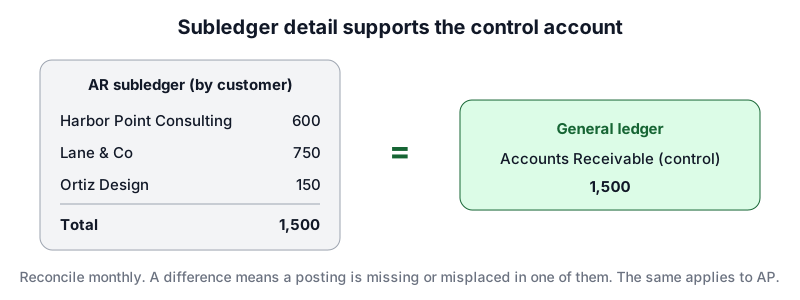
Look at individual customers and suppliers as well. A receivables subledger can show a normal total while one customer has a credit balance. The subledgers and control accounts lesson explains how the detail must agree with the control account.
Step 2: scan the detail for common errors
Read the detail of each account with one question in mind: does each line belong here, once, in this period?
Duplicates
Look for two lines with the same amount, payee and date (or dates a few days apart). Duplicates often appear when a transaction is entered by hand and then imported again from a bank feed. The reversals and duplicates lesson covers how to remove them cleanly.
Misclassification
An error of principle is an entry posted to the wrong type of account, such as a capital purchase recorded as an expense. See the glossary entry on the error of principle. Scan expense accounts for large single purchases that may be equipment, and asset accounts for small items that should have been expensed. Apply the business's own capitalization policy; the capitalizing fixed assets lesson explains the idea.
Personal costs
Watch for items that look personal: groceries, family meals, home utilities or personal subscriptions paid from the business account. In a sole proprietorship these are owner's drawings, not expenses.
Wrong period
Check entries near the start and end of the month. A December bill recorded in January moves an expense between months and between years. The cutoff lesson shows how to test dates.
Deposits recorded as revenue
Read the revenue accounts for deposits that aren't sales. Loan proceeds, transfers between the business's own accounts, refunds from suppliers and money the owner put in all arrive as bank deposits, and a bank feed can sort any of them into revenue. Each overstates income. For a fictional $2,000 the owner transferred in from a personal account that was recorded as Service revenue:
| Account | Debit | Credit |
|---|---|---|
| Reclassify an owner contribution recorded as revenue | ||
| Service Revenue | $2,000.00 | |
| Owner Capital | $2,000.00 | |
Missing or vague descriptions
Lines with no description, round amounts with no source or entries labeled "misc" deserve a check against the source document. The IRS recordkeeping page notes that good records help you monitor the progress of your business, and a line you can't explain doesn't help anyone. If an "uncategorized" account has built up, the post on cleaning up uncategorized transactions has a triage process.
Step 3: compare each account to prior months
Put this month next to the last three to six months for every revenue and expense account. Look for:
- An account that jumps or drops sharply with no business reason.
- A recurring cost (rent, insurance, software) that is missing or appears twice.
- An account that is new this month.
- Revenue that moved but cost of goods sold didn't, or the reverse.
A swing isn't an error by itself. A slow month or a one-off purchase can explain it. The test is whether you can name the reason.
A worked example with four findings
Cedar Row Consulting is a fictional sole proprietorship. Its owner reviews the April ledger after reconciling the bank. The trial balance balances, but the review finds four problems.
Finding 1: a utility bill entered twice
The April bank reconciliation left one $284.00 payment in the books that never appeared on the bank statement. The ledger shows why: Utilities expense has two $284.00 payments to the power company on April 12. The second line came from the bank feed after the payment had already been entered by hand, so the duplicate overstated the expense and understated Cash. Reverse the extra line:
| Account | Debit | Credit |
|---|---|---|
| April 30: remove duplicate utility payment | ||
| Cash | $284.00 | |
| Utilities Expense | $284.00 | |
Finding 2: a laptop posted to supplies
Supplies expense jumped from about $150 a month to $2,010. The detail shows a $1,850 laptop. The business's written policy is to capitalize equipment costing $1,000 or more, so the laptop is an asset:
| Account | Debit | Credit |
|---|---|---|
| April 30: reclassify laptop from supplies to equipment | ||
| Equipment | $1,850.00 | |
| Supplies Expense | $1,850.00 | |
Depreciation on the laptop then starts under the business's normal method. The straight-line depreciation lesson shows the calculation.
Finding 3: a family dinner on the business card
Meals expense includes an $86.40 restaurant charge from a Saturday evening. The receipt shows it was a family dinner. Move it to drawings:
| Account | Debit | Credit |
|---|---|---|
| April 30: reclassify personal meal to owner's drawings | ||
| Owner Drawings | $86.40 | |
| Meals Expense | $86.40 | |
Finding 4: a supplier with a debit balance
Accounts payable for one supplier shows a $640.00 debit balance. The detail shows the same $640 invoice paid twice, once by check and once by card. The owner asks the supplier for a refund. While waiting, the debit balance correctly shows that the supplier owes the business money. When the refund arrives:
| Account | Debit | Credit |
|---|---|---|
| May 9: refund received for duplicate supplier payment | ||
| Cash | $640.00 | |
| Accounts Payable | $640.00 | |
The correcting entries lesson explains the method behind each of these: compare what was posted with what should have been posted, then record only the difference.
A general ledger review checklist
Use this list each month. Tick each line and note what you found.
| Check | Done |
|---|---|
| Bank and credit cards reconciled | |
| Trial balance in balance | |
| No unexplained wrong-side balances, including customer and supplier detail | |
| Receivables and payables subledgers agree with control accounts | |
| Loan balances agree with lender statements | |
| No duplicates in expense, revenue or payables accounts | |
| Large expenses checked against the capitalization policy | |
| Personal items moved to owner's drawings | |
| Entries near month-end checked for cutoff | |
| Suspense or uncategorized accounts at zero | |
| Each revenue and expense account compared with prior months | |
| Correcting entries posted with notes |
Keep a review log
For each correction, write the date, account, amount, what was wrong and the source document you used. The log makes next month's review faster and answers questions from an accountant or tax preparer later.
Frequently asked questions
How often should I review the general ledger?
Monthly, as part of the month-end close, after the reconciliations. A monthly review keeps each correction small and recent enough to remember.
Should I delete a wrong entry or post a correcting entry?
In an open period, deleting a true duplicate is common practice. Once a period is closed or reported, post a correcting entry instead so the history stays visible.
Do I need to review every line?
Not always. Review every line in accounts with problems, and in the rest focus on large items, unusual payees and month-end dates.
A ledger review is also one step in our year-end bookkeeping checklist for small businesses.
Many of the errors a review finds are on our list of 12 common bookkeeping mistakes.
What to practice next
The fastest way to get good at ledger reviews is to fix many small errors. Work through the correcting entry practice set, then use the T-accounts and general ledger simulator to practice reading an account's postings line by line.
Sources
- 3.6 Prepare a Trial Balance — OpenStax
- Publication 583, Starting a Business and Keeping Records — IRS
- Recordkeeping — IRS
Educational content for US small-business bookkeeping, not tax, legal or accounting advice. Example businesses and figures are fictional. See our editorial policy for how we write and correct content.