Cleanup and reconciliation
Year-end bookkeeping checklist for small businesses
A year-end checklist for small-business books, from reconciliations and inventory counts to accruals, closing entries and the package for your tax preparer.
By TNas · · 8 min read
Year-end bookkeeping means making the books for the whole year complete and correct, then closing them. In practice that's a fixed sequence: reconcile every cash, card and loan account; check receivables, payables and inventory against evidence; record the year-end adjusting entries; review the trial balance; post closing entries; and hand your tax preparer a clean package. The checklist below follows that order.
It builds on the monthly close. If you've closed every month properly, year-end is the December close plus a few extra steps. If you haven't, start by catching up the missing months.
The year-end checklist at a glance
A year-end close is the final close of the accounting year: the December month-end close plus the reviews, adjustments and closing entries that reset the books for the new year.
| Step | Task | Done when |
|---|---|---|
| 1 | Record every transaction dated in the year | No unentered receipts, bills or invoices remain |
| 2 | Reconcile bank, card, loan and clearing accounts | Each ledger balance agrees with its December statement |
| 3 | Review accounts receivable | Every customer balance is real and collectible, or written off |
| 4 | Review accounts payable | Every supplier balance agrees with the supplier's records |
| 5 | Count inventory | The Inventory account equals the counted cost |
| 6 | Update fixed assets and depreciation | The asset list agrees with the ledger and depreciation is posted |
| 7 | Record accruals and deferrals | Expenses and revenue sit in the year they belong to |
| 8 | Prepare payroll and contractor forms | Year-end forms are ready on time |
| 9 | Review the adjusted trial balance | No unusual balances, suspense or uncategorized items |
| 10 | Post closing entries | All temporary accounts are zero |
| 11 | Send the tax preparer's package and lock the year | The period is locked and the files are backed up |
The rest of this guide explains each step, with the journal entries for a fictional small retailer, Cedar Hill Supply, which keeps its books on the accrual basis and uses the calendar year.
Steps 1 and 2: finish recording and reconcile everything
The IRS describes a tax year in Publication 538 as an annual accounting period for keeping records and reporting income and expenses. A calendar year is the 12 months from January 1 to December 31. Your books need every transaction dated inside that period, so start by chasing down the stragglers: December bills that arrive in January, card charges without receipts, and invoices that were promised but never sent. The period cutoff lesson explains how to decide which year a transaction belongs to.
Then reconcile every balance-sheet account that has an outside statement, such as a bank, card issuer or lender statement:
- Bank accounts to the December 31 bank statement. See bank reconciliation basics.
- Credit cards to the December statement. The guide on how to reconcile a business credit card statement walks through it.
- Loans to the lender's year-end statement, so the principal balance is right and the year's interest expense is complete.
- Clearing and holding accounts, such as undeposited funds, suspense and uncategorized income or expense. These should be zero or fully explained. The guide to what a suspense account is and how to clear it covers the cleanup.
Reconcile first. Every adjustment after this point depends on Cash and the liabilities being right.
Steps 3 and 4: review receivables and payables
Accounts receivable
Print the aged receivables report and compare its total with the Accounts receivable control account. The two must agree, as the subledgers and control accounts lesson explains. Then go customer by customer:
- Is each open invoice real, or was a payment applied to the wrong invoice?
- Are any credit balances actually unapplied payments or credit notes?
- Which old balances won't be collected?
Under the allowance method, a specific account you decide not to pursue is written off against the allowance, not to a new expense. Cedar Hill writes off a $300.00 balance from a customer that closed:
| Account | Debit | Credit |
|---|---|---|
| Dec 31: write off an uncollectible customer balance | ||
| Allowance for Doubtful Accounts | $300.00 | |
| Accounts Receivable | $300.00 | |
Then review whether the remaining allowance is a reasonable estimate for the receivables left. The bad debts and the allowance method lesson shows the estimate entry.
Accounts payable
Compare the unpaid bills report with the Accounts payable control account, and match large supplier balances to the suppliers' own statements. Look for debit balances (often a duplicate payment), bills entered twice, and December bills that are still missing. The reconciling payables lesson covers the supplier statement match.
Step 5: count inventory
If you sell goods, count what is actually on hand at year-end and value it at cost. Publication 538 says that a business keeping a book inventory must take a physical inventory at reasonable intervals, and the book amount must be adjusted to agree with the actual inventory.
Cedar Hill's Inventory account shows $18,400.00, but the December 31 count values the stock at $17,950.00. The $450.00 shortfall is shrinkage, recorded as part of cost of goods sold, as in the returns and shrinkage lesson:
| Account | Debit | Credit |
|---|---|---|
| Dec 31: adjust inventory to the physical count | ||
| Cost of Goods Sold | $450.00 | |
| Inventory | $450.00 | |
Step 6: update fixed assets and depreciation
Compare the fixed asset list with the ledger. Add assets bought during the year, remove assets sold or scrapped (see disposing of fixed assets), and post the year's depreciation.
Cedar Hill bought shelving and equipment for $14,000.00 at the start of the year, with an estimated $2,000.00 salvage value and a five-year useful life. Straight-line depreciation is (14,000.00 − 2,000.00) ÷ 5 = 2,400.00 per year:
| Account | Debit | Credit |
|---|---|---|
| Dec 31: depreciation for the year | ||
| Depreciation Expense | $2,400.00 | |
| Accumulated Depreciation – Equipment | $2,400.00 | |
Book depreciation and tax depreciation can follow different rules. Your tax preparer handles the tax side; your job is an accurate asset list with dates and costs.
Step 7: record accruals and deferrals
Adjusting entries put revenue and expenses in the year they belong to. At year-end, check at least these:
- Accrued wages. Employees worked December 29 to 31, but payday is January 2. Those wages are a December expense.
- Prepaid expenses. Insurance or software paid in advance is an asset until it is used up. The prepaid insurance schedule and annual software subscriptions posts show the monthly entries.
- Unbilled revenue and unearned revenue. Work done but not invoiced, or cash received for work not yet done.
- Accrued interest and utilities. Costs incurred in December and billed in January.
Cedar Hill's two adjustments:
| Account | Debit | Credit |
|---|---|---|
| Dec 31: wages earned Dec 29 to 31, paid Jan 2 | ||
| Wages Expense | $1,280.00 | |
| Wages Payable | $1,280.00 | |
| Dec 31: three months of a 2,400.00 annual policy paid Oct 1 | ||
| Insurance Expense | $600.00 | |
| Prepaid Insurance | $600.00 | |
The insurance figure is 2,400.00 ÷ 12 = 200.00 per month, times the three months from October to December. The accruals and deferrals lessons cover each type.
Step 8: prepare payroll and contractor forms
Year-end is also when information returns come due. Check the current IRS instructions each year, because dates and thresholds change.
- Form W-2. The General Instructions for Forms W-2 and W-3 (2026) give February 1, 2027 as the due date for filing 2026 Forms W-2 with the Social Security Administration and for furnishing copies to employees.
- Form 1099-NEC. The Instructions for Forms 1099-MISC and 1099-NEC say Form 1099-NEC must be filed on or before January 31, with the due date moving to the next business day when that falls on a weekend or legal holiday. The same instructions say that for tax years beginning after 2025, the reporting threshold for nonemployee compensation increased to $2,000.
The bookkeeping job here is to make sure each contractor's total for the year is correct and that you have their name, address and taxpayer identification number on file. Whether a payment is reportable is a tax question; ask a tax professional about your situation.
Step 9: review the adjusted trial balance
Run the adjusted trial balance and read it line by line before closing:
- Does every account have its normal balance? A credit balance in an expense account or a debit balance in Accounts payable needs explaining.
- Are suspense, uncategorized and clearing accounts at zero?
- Do the big numbers make sense compared with last year?
- Does Owner drawings agree with what the owner actually took out?
Fix anything odd now. Corrections after closing are harder, which is why the month-end checklist puts review before close.
Step 10: post the closing entries
Closing entries reset the temporary accounts (revenue, expenses and drawings) to zero and move the year's result into Owner capital through Income summary.
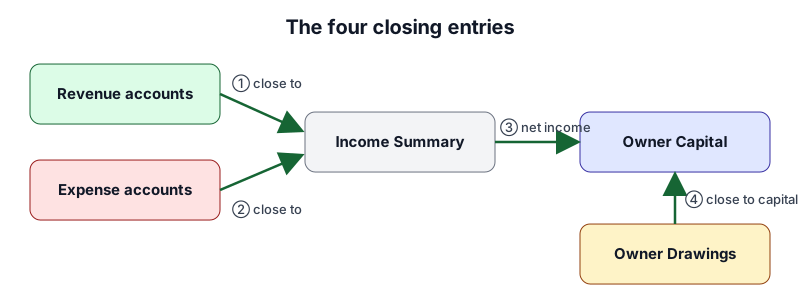
After the adjustments above, Cedar Hill's temporary accounts show sales revenue of $184,000.00, expenses of $164,500.00 and owner drawings of $15,000.00. Net income is 184,000.00 − 164,500.00 = 19,500.00.
| Account | Debit | Credit |
|---|---|---|
| Dec 31: close revenue | ||
| Sales Revenue | $184,000.00 | |
| Income Summary | $184,000.00 | |
| Dec 31: close expenses | ||
| Income Summary | $164,500.00 | |
| Cost of Goods Sold | $98,500.00 | |
| Wages Expense | $42,000.00 | |
| Rent Expense | $18,000.00 | |
| Utilities Expense | $3,000.00 | |
| Insurance Expense | $600.00 | |
| Depreciation Expense | $2,400.00 | |
| Dec 31: close net income to capital | ||
| Income Summary | $19,500.00 | |
| Owner Capital | $19,500.00 | |
| Dec 31: close drawings to capital | ||
| Owner Capital | $15,000.00 | |
| Owner Drawings | $15,000.00 | |
The expense credits add up to 98,500.00 + 42,000.00 + 18,000.00 + 3,000.00 + 600.00 + 2,400.00 = 164,500.00. Owner capital rises by the $19,500.00 profit and falls by the $15,000.00 of drawings, a net increase of $4,500.00. Drawings close straight to capital, not through Income summary, as the closing entries lesson explains. Many accounting programs perform this close automatically when the new year starts, but the result is the same.
Finish with a post-closing trial balance: it should list only assets, liabilities and Owner capital.
Step 11: the tax preparer's package and record keeping
Give your tax preparer what they need in one go:
| Document | Why |
|---|---|
| Income statement and balance sheet for the year | The core figures |
| Year-end trial balance | Every account balance in one list |
| Bank, card and loan reconciliations | Proof that the balances are right |
| Fixed asset list with additions and disposals | Depreciation and any sale of assets |
| Inventory count and valuation | Cost of goods sold |
| Payroll summaries and contractor totals | Wages and information returns |
| Owner contributions and drawings | Equity changes |
Then lock the year in your accounting software so nobody changes it by accident. Keep the records. The IRS page How long should I keep records? gives 3 years as the general period, with longer periods in some situations. It says to keep employment tax records for at least 4 years after the tax becomes due or is paid, whichever is later.
Practice the year-end close
The skills that matter most here are adjusting and closing entries. Work through the adjusting entries practice and the closing entries practice, then run a full close end to end in the month-end close simulator.
Sources
- Publication 538, Accounting Periods and Methods — IRS
- Instructions for Forms 1099-MISC and 1099-NEC — IRS
- General Instructions for Forms W-2 and W-3 (2026) — IRS
- How long should I keep records? — IRS
Educational content for US small-business bookkeeping, not tax, legal or accounting advice. Example businesses and figures are fictional. See our editorial policy for how we write and correct content.