Cleanup and reconciliation
How to reconcile a business credit card statement
Match a business credit card statement to your ledger, sort timing items from real errors, and post the entries that make the balances agree.
By TNas · · 9 min read
To reconcile a business credit card statement, you compare the balance the card issuer says you owe on the statement date with the Credit card payable balance in your ledger, then explain every difference. Differences fall into two groups: timing items you adjust on the statement side, and items your books missed or got wrong, which you fix with journal entries. When both adjusted balances match to the cent, the card is reconciled.
The method is the same one you use for a bank reconciliation, with one twist: a credit card is a liability, so its normal balance is a credit and every direction is flipped compared with Cash.
Why reconcile a credit card at all
A credit card reconciliation is a comparison of the card issuer's statement with your own ledger that explains every difference between the two balances on the statement date.
A business credit card is a short-term debt. Every purchase increases what you owe, and every payment or refund reduces it. Your ledger tracks this in a liability account, usually called Credit card payable, and the card issuer keeps its own record. If the two disagree, either your books are wrong or the issuer made a mistake, and you only find out by comparing them.
Skipping the reconciliation causes three common problems:
- Missing expenses. Charges with no receipt never get recorded, so expenses are understated and profit looks better than it is.
- Missing fees and interest. The issuer adds these on the statement. Nobody hands you a receipt for them.
- Personal spending mixed in. A personal purchase on the business card is not a business expense, and it has to be recorded as one of the owner's draws.
The statement also matters as a record. The IRS lists "credit card receipts and statements" among the supporting documents for purchases and expenses on its What kind of records should I keep page. IRS Publication 583 adds that a card statement can serve as proof of payment when it shows the amount charged, the payee and the transaction date. It also cautions that proof of payment alone does not show the cost was a deductible business expense. You still want the receipt or invoice behind each charge. For how any of this applies to your own return, ask a tax professional.
What you need before you start
Gather these before you open your accounting software:
| Item | Where it comes from | What you use it for |
|---|---|---|
| The card statement for the period | Card issuer | Statement closing date and ending balance |
| Last month's reconciliation | Your files | Timing items that should clear this month |
| The Credit card payable ledger | Your general ledger | Every charge, payment and refund you recorded |
| Receipts and invoices | Email, receipt app, paper files | Support for each charge, and the right expense account |
Use the statement closing date, not the end of the calendar month, as the date you reconcile to. If the statement closes on October 28, you compare the ledger balance as of October 28.
Step by step: matching the statement to the ledger
Work through the statement line by line and tick each item that also appears in the ledger with the same amount. The matching transactions lesson covers the technique in detail; for a card, the steps look like this:
- Start with the ending balances. Write down the statement balance (what the issuer says you owe) and the ledger balance on the same date.
- Clear last month's timing items. Anything listed as "not yet on the statement" last month should appear on this one. If it doesn't, find out why.
- Tick matching charges. Match each statement charge to a ledger charge by date, payee and amount.
- Tick payments and refunds. Payments from your bank account and merchant refunds both reduce the balance.
- List what is left on each side. Unticked statement lines are things your books missed. Unticked ledger lines are either timing items or errors.
- Classify and adjust. Put timing items on the statement side. Record journal entries for everything else.
- Prove it. Both adjusted balances must be identical.
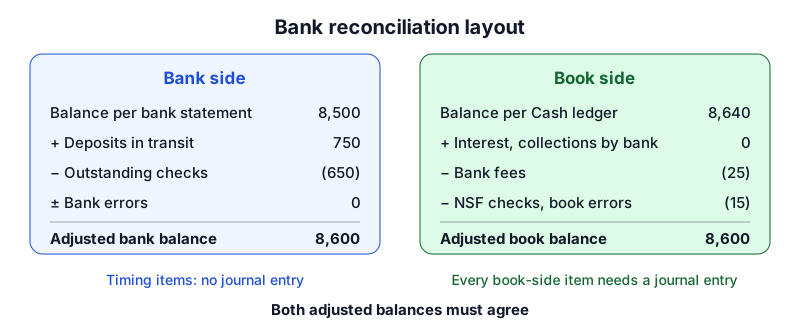
The diagram shows a bank account, but the logic carries over. As the OpenStax Principles of Accounting chapter on bank reconciliations puts it, transactions the bank knows about but the company does not "must be journalized" in the company's records. The card issuer plays the bank's role here.
Timing items vs book-side items
Getting this classification right is most of the job.
Timing items are entries you recorded correctly that the issuer has not posted yet. They will show up on next month's statement without anyone doing anything.
- A charge you recorded on October 27 that the issuer posts on October 30, after the statement closed.
- A payment you sent on October 27 that the issuer credits on October 30.
Timing items adjust the statement balance. They never get a journal entry, because your books are already right.
Book-side items are things the issuer recorded that your books don't have, or amounts your books recorded wrongly.
- Annual fees, late fees and foreign transaction fees.
- Interest on a carried balance.
- Charges with no receipt that never got entered.
- Merchant refunds credited to the card.
- Typing errors, such as a transposition of two digits.
Book-side items adjust the ledger balance, and each one needs a journal entry. The book adjustments lesson explains the bank version of the same rule.
A worked example
Harbor Lane Studio is a fictional design business with one business credit card. The October statement closes on October 28 and shows a balance owed of $4,936.57. On the same date, the Credit card payable account in the ledger shows a credit balance of $4,415.90. The difference is $520.67, and the bookkeeper's job is to explain all of it.
After ticking every matched line, these items are left over:
| Item | On statement? | In ledger? | Type |
|---|---|---|---|
| Advertising charge, Oct 27, $210.00 | No | Yes | Timing (statement side) |
| Payment from bank, Oct 27, $500.00 | No | Yes | Timing (statement side) |
| Annual card fee, $95.00 | Yes | No | Book side |
| Interest charge, $38.17 | Yes | No | Book side |
| Office supplies, receipt lost, $129.00 | Yes | No | Book side |
| Personal streaming subscription, $42.00 | Yes | No | Book side |
| Refund from office supply store, $64.50 | Yes | No | Book side |
| Advertising charge of $245.00 entered as $254.00 | Yes | Yes, wrong amount | Book side (error) |
The reconciliation
| Statement side | Amount | Ledger side | Amount |
|---|---|---|---|
| Statement balance owed | 4,936.57 | Credit card payable balance | 4,415.90 |
| Add: charge not yet posted | 210.00 | Add: annual fee | 95.00 |
| Less: payment not yet posted | (500.00) | Add: interest | 38.17 |
| Add: unrecorded supplies | 129.00 | ||
| Add: personal charge | 42.00 | ||
| Less: refund | (64.50) | ||
| Less: advertising overstatement | (9.00) | ||
| Adjusted statement balance | 4,646.57 | Adjusted ledger balance | 4,646.57 |
Both sides agree at $4,646.57, so the remaining work is to post the ledger-side items.
Notice the advertising error: the difference between $254.00 and $245.00 is $9.00, which divides evenly by 9. That pattern is a classic sign of a transposition. The finding differences lesson shows how to use clues like this.
The adjusting journal entries
Date each entry at the statement closing date and reference the statement in the memo. Remember the direction: charges, fees and interest increase the liability (credit Credit card payable), while refunds and overstatements decrease it (debit Credit card payable).
| Account | Debit | Credit |
|---|---|---|
| Oct 28: annual card fee from the statement | ||
| Bank Fees Expense | $95.00 | |
| Credit Card Payable | $95.00 | |
| Oct 28: interest charged on the carried balance | ||
| Interest Expense | $38.17 | |
| Credit Card Payable | $38.17 | |
| Oct 28: office supplies charge with no receipt on file | ||
| Supplies Expense | $129.00 | |
| Credit Card Payable | $129.00 | |
| Oct 28: owner's personal subscription charged to the business card | ||
| Owner Drawings | $42.00 | |
| Credit Card Payable | $42.00 | |
| Oct 28: refund from the office supply store | ||
| Credit Card Payable | $64.50 | |
| Supplies Expense | $64.50 | |
| Oct 28: correct advertising entered as 254.00 instead of 245.00 | ||
| Credit Card Payable | $9.00 | |
| Advertising Expense | $9.00 | |
After posting, the ledger rises by 95.00 + 38.17 + 129.00 + 42.00 = 304.17 and falls by 64.50 + 9.00 = 73.50, a net increase of 230.67. The new balance is 4,415.90 + 230.67 = 4,646.57, which equals the adjusted statement balance. The two timing items need nothing: next month's statement should show the $210.00 charge and the $500.00 payment.
The error fix only records the $9.00 difference rather than reversing and re-entering the whole charge. Both approaches are valid; the correcting entries lesson covers when each is clearer.
Missing receipts, personal charges and other judgment calls
When a receipt is missing
A charge on the statement is real debt even without a receipt, so it still gets recorded. Request a copy from the vendor (most can resend an emailed receipt), note the missing document in your reconciliation file, and pick the expense account based on what the charge was for. If you truly cannot tell what a charge was, don't guess. Park it in a holding account and investigate, as explained in the suspense account guide, and clear it before you close the month.
Personal purchases on the business card
The cleanest fix is to stop it from happening, but when it does, record the charge as Owner drawings for a sole proprietor or single-member LLC. It reduces the owner's equity, not profit. The owner drawings glossary entry explains why draws are not expenses. If the owner later pays that amount from a personal account, record it as a contribution: debit Credit card payable and credit Owner capital.
Charges that are really assets or prepayments
A $3,000 laptop charged to the card is equipment, not supplies. A year of software paid in one charge may be a prepayment. Reconciling is a good moment to catch these. See capitalizing fixed assets for the asset test.
When the balances still don't agree
If you have classified every item and the adjusted balances still differ, work through this list:
- Check the opening balance. Did last month's reconciliation finish at the ledger balance you started from? A changed prior-month entry breaks the chain.
- Look for duplicates. Bank feeds sometimes import the same charge twice, once as pending and once as posted.
- Check signs. A refund entered as a charge creates a difference of twice the refund amount.
- Divide by 9. A difference divisible by 9 suggests a transposition or a misplaced decimal.
- Check the payment account. A card payment recorded as an expense instead of a debit to Credit card payable leaves the liability too high.
Never plug the difference to a miscellaneous expense to make it go away. An unexplained gap means something is wrong in the books, and a plug hides it.
Practice reconciling
The fastest way to get good at this is to reconcile a few statements where you can check your answer. Work through the bank reconciliation exercises, which drill the same timing-versus-book-side logic, then try the bank reconciliation simulator for a full statement. For the day-to-day card entries themselves, read how to record business credit card purchases and payments, and if card charges have piled up unsorted, the guide to cleaning up uncategorized transactions will help you clear them first.
Sources
- Publication 583, Starting a Business and Keeping Records — IRS
- What kind of records should I keep — IRS
- 8.6 Define the Purpose of a Bank Reconciliation, and Prepare a Bank Reconciliation and Its Associated Journal Entries — OpenStax
Educational content for US small-business bookkeeping, not tax, legal or accounting advice. Example businesses and figures are fictional. See our editorial policy for how we write and correct content.