Cleanup and reconciliation
Catch-up bookkeeping: how to fix months of missed books
A step-by-step order of work for catching up months of missed bookkeeping, from gathering statements to month-by-month reconciliations and correcting entries.
By TNas · · 7 min read
To catch up months of missed bookkeeping, start from the last point the books were known to be correct, gather every statement for the gap, and then work one month at a time from the oldest. In each month, record the transactions and reconcile each bank and card account before you move on. Finish by fixing what the reconciliations turn up and reviewing the trial balance. Working in this order keeps one error from spreading into every month after it.
The business and figures in the examples are fictional.
Why order matters in catch-up work
Behind books are tempting to fix all at once: import a year of bank transactions, categorize them in a rush and hope the totals look right. That approach hides errors. If January's opening balance is wrong, every month after it is wrong too, and a reconciliation in December can't tell you which month broke.
Good records matter beyond tidiness. The IRS notes that good records help you monitor the progress of your business and keep track of deductible expenses (IRS, Recordkeeping). Catch-up work rebuilds that record so the balance sheet and income statement can be trusted again.
The order of work below follows the same accounting cycle as normal bookkeeping, just repeated month by month.
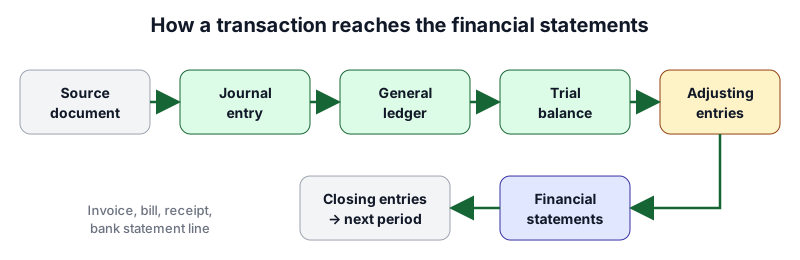
Step 1: Find the last good starting point
Before entering anything, decide where the clean books end. That date is the starting point for everything else.
Good starting points, from most to least reliable:
- The last month that was fully reconciled, with bank and card balances that matched the statements.
- The last filed tax return's balance sheet, if the business files one, or the year-end figures the tax preparer used.
- The business's start date, if the books were never kept properly.
Then check the opening balances on that date. Cash should match the bank statement, credit card balances should match the card statements, and loan balances should match the lender's statement. If the books never existed, the planned post on opening balances for an existing business explains how to build them.
Write down the starting date and the source of each opening balance. When something doesn't tie later, this note is the first thing you will check.
Step 2: Gather the documents
Statements come first, because they are complete and independent of your records. Collect, for every month in the gap:
| Document | Why you need it |
|---|---|
| Bank statements, every account | The record of every deposit and payment |
| Credit card statements | Card purchases, payments and fees |
| Loan and line-of-credit statements | Principal and interest split, ending balances |
| Payment processor reports | Gross sales, fees and payouts |
| Sales invoices and receipts | What was sold, to whom, and what is still owed |
| Supplier bills | What was bought and what is still unpaid |
| Payroll reports | Gross pay, withholdings and employer taxes |
| Receipts for larger purchases | Equipment or vehicles that need to be capitalized |
The IRS lists the kinds of source documents that support business records, such as cash register tapes, deposit information, invoices, canceled checks, account statements and credit card receipts and statements (IRS, What kind of records should I keep). You won't always have every receipt. The statements tell you what happened; receipts and invoices tell you what it was for.
It also helps to know how far back you may need records. The IRS's general guidance is to keep records for 3 years, with longer periods in some situations. Employment tax records should be kept for at least 4 years after the tax becomes due or is paid, whichever is later (IRS, How long should I keep records?).
Step 3: Record and reconcile one month at a time
Work the oldest month first. For each month:
- Enter or import that month's bank and card transactions.
- Categorize each one to the right account, using invoices, bills and receipts.
- Match customer payments to invoices and supplier payments to bills, so accounts receivable and accounts payable stay accurate.
- Reconcile every bank and card account to the month-end statement.
- Record the month's non-cash entries: depreciation, prepaid expenses used, loan interest splits.
- Lock or mark the month as done before starting the next.
A bank reconciliation compares the bank's ending balance with your book balance and explains every difference. Items like deposits in transit and outstanding checks are timing differences. Items only the bank knows about, such as service fees, need entries in your books. For example, if February's statement shows a $45.00 monthly fee nobody recorded:
| Account | Debit | Credit |
|---|---|---|
| February 28: record the bank service fee found during reconciliation | ||
| Bank Fees Expense | $45.00 | |
| Cash | $45.00 | |
The bank reconciliation steps guide walks through a full reconciliation if you need a refresher.
Don't move on until the month reconciles to the cent. A $12 difference in March is easy to find in March. The same $12 hidden among nine months of transactions is not.
Step 4: Clear the holding accounts
Catch-up work usually leaves amounts in holding accounts: "Uncategorized income", "Uncategorized expense", "Ask my accountant" or a suspense account. A holding account is a temporary place for a transaction whose correct account isn't known yet. The goal is a zero balance in every one of them.
Clear them with reclassifying entries, not by deleting transactions. A reclassifying entry moves an amount from the wrong account to the right one and leaves a clear trail.
For example, fictional Lakeside Tutoring imported its bank deposits and $3,200.00 landed in Uncategorized income. Matching them to customer remittances shows they were payments on invoices already recorded in Accounts receivable. Leaving them in income would count the same revenue twice, once on the invoice and once on the deposit.
| Account | Debit | Credit |
|---|---|---|
| March 31: reclassify customer payments recorded as uncategorized income | ||
| Uncategorized Income | $3,200.00 | |
| Accounts Receivable | $3,200.00 | |
Another common find: the owner paid a $600.00 business advertising bill with a personal card, and it never reached the books. If the owner doesn't expect repayment, it is an owner contribution:
| Account | Debit | Credit |
|---|---|---|
| April 30: record a business bill the owner paid personally | ||
| Advertising Expense | $600.00 | |
| Owner Capital | $600.00 | |
The planned post on cleaning up uncategorized transactions gives a full triage process for large backlogs.
Step 5: Fix the errors that reconciliations reveal
Some errors only show up when you compare your balances to third-party statements. Loan balances are the classic case.
Suppose Lakeside Tutoring recorded six $500.00 loan payments, $3,000.00 in total, entirely to Interest expense. The lender's statement shows that $420.00 of that was interest and $2,580.00 reduced principal. The books overstate expenses by $2,580.00 and overstate the loan balance by the same amount.
| Account | Debit | Credit |
|---|---|---|
| June 30: correct loan payments recorded entirely as interest | ||
| Notes Payable | $2,580.00 | |
| Interest Expense | $2,580.00 | |
After the entry, Interest expense shows $3,000.00 − $2,580.00 = $420.00, matching the lender, and notes payable agrees to the statement. The correcting entries lesson explains how to build a correction from "what was recorded" and "what should have been recorded".
Other checks for each catch-up period:
- Duplicates. Imported bank feeds plus manually entered bills often create the same payment twice. The reversals and duplicates lesson covers how to remove them.
- Fixed assets expensed. A large equipment purchase coded to an expense account needs to be moved to the asset account and depreciated.
- Personal spending on business accounts. Record it as owner drawings, not as a business expense.
- Receivables and payables. Compare the AR and AP subledgers to their control accounts, and follow up on very old open items.
Step 6: Review the trial balance and close each month
When every month in the gap is reconciled, run a trial balance for each month-end and read it account by account. Look for balances on the wrong side, accounts that should be zero but aren't, and month-to-month swings with no explanation.
A balancing trial balance doesn't prove the books are right. Some errors leave debits and credits equal, which the lesson on errors a trial balance cannot find describes. If the balance sheet doesn't balance at all, look first for one-sided entries and for transactions posted to the wrong side, then use the trial balance errors guide to narrow the search.
Finally, set up a routine so the gap doesn't reopen. The month-end close guide lists the tasks to repeat every month.
When to bring in a CPA or tax professional
Catch-up bookkeeping fixes the records. Some problems go beyond the records, and those need a licensed professional:
- Tax returns weren't filed for one or more years during the gap.
- Tax notices have arrived, for example about payroll taxes or unreported income.
- A filed return's numbers change after the cleanup, so an amended return may be needed.
- Payroll was run without remitting withholdings.
- The business structure changed during the gap (for example, a sole proprietorship became an LLC or added a partner).
Give the professional the reconciled books, the list of correcting entries and your notes on starting balances. A clean, documented set of books makes their work faster and easier to check.
Once the books are current, the year-end bookkeeping checklist for small businesses walks through closing out the year.
What to practice next
Catch-up work is mostly two skills repeated many times: reconciling an account to a statement and writing a correcting entry. Build both with the bank reconciliation exercises and the correcting entry practice. When your corrections are in, the trial balance error exercises train you to spot what still doesn't add up.
Sources
Educational content for US small-business bookkeeping, not tax, legal or accounting advice. Example businesses and figures are fictional. See our editorial policy for how we write and correct content.