Cleanup and reconciliation
How to reconcile a loan balance to the lender statement
Compare your Notes payable balance to the lender's principal balance, find why they differ, and post the correcting entry, with a worked example.
By TNas · · 8 min read
To reconcile a loan, compare the balance of the loan account in your books (usually Notes payable) with the principal balance on the lender's statement for the same date. If they differ, list every payment, split each one into interest and principal using the lender's figures, and post a correcting entry for whatever was misposted. The most common cause is simple: whole payments were recorded as interest expense, so the loan never went down in the books.
What a loan reconciliation checks
A loan reconciliation is a check that the loan balance in your books agrees with the lender's own record of the same loan. It is the same idea as a bank reconciliation: an outside party keeps its own record, and you prove the two agree. For a loan, the outside record is the lender's statement, online loan portal or amortization schedule.
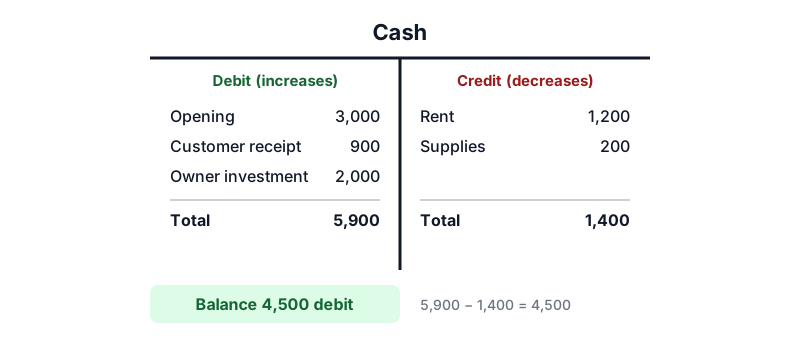
The account you are checking is a liability. Most small businesses record a term loan in Notes payable. Notes payable is the liability account for money owed under a written promise to repay, and it has a credit normal balance. Borrowing increases it with a credit. Each principal repayment decreases it with a debit.
These lender figures matter, and each has one home in your books:
| Lender figure | Where it belongs in your books |
|---|---|
| Principal balance remaining | Must equal the Notes payable balance |
| Interest paid this period | Interest expense on the income statement |
| Principal paid this period | Debits to Notes payable |
| Fees, late charges, escrow | Their own accounts, never mixed into principal |
If you have more than one loan, give each its own account or subaccount (for example "Notes payable, equipment loan") so each one can be reconciled to its own statement.
Why loan balances drift away from the lender
Most differences come from a short list of causes. Knowing them in advance makes the search much faster.
The whole payment was expensed
This is the big one. A bank feed shows a single withdrawal of $912.66 to the lender, and someone categorizes the whole amount as Interest expense. The expense is overstated, net income is understated, and Notes payable stays at the original loan amount forever. The book balance ends up higher than the lender's balance, and the gap grows every month by the principal portion of each payment.
Principal and interest split was estimated
Some people split payments using a rough rate or an online calculator. Lenders often calculate interest on a daily balance, so the real split differs by a few dollars each month. Over a year those differences add up. As OpenStax explains in its section on current liabilities, each payment on an amortizing loan pays interest first and the rest reduces principal, so the split changes every month. Always take the split from the lender.
Proceeds were recorded net of fees
If the lender withheld a fee from the loan proceeds, the bank deposit is smaller than the loan. Recording the note at the deposit amount makes the book balance too low from day one.
A payment is missing, doubled or in the wrong month
Three timing slips cause trouble: an automatic payment that was never recorded, a payment entered twice (once from the bank feed and once by hand), and a payment dated in the wrong month. Each creates a difference equal to one payment's principal portion. The reversals and duplicates lesson covers how to spot doubled entries.
Extra payments, late fees and escrow
An extra principal payment reduces the loan more than the schedule shows. A late fee is an expense, not principal. A mortgage-style payment that includes escrow for property tax or insurance carries amounts that belong in neither interest nor principal.
A worked example: three payments posted as interest
The business and figures below are fictional.
Harbor Lane Bakery borrows $30,000 on January 1 at 6% annual interest, repaid in 36 monthly payments of $912.66 at each month-end. The lender's amortization schedule shows the split for the first quarter:
| Payment date | Payment | Interest | Principal | Principal balance |
|---|---|---|---|---|
| January 1 | 30,000.00 | |||
| January 31 | 912.66 | 150.00 | 762.66 | 29,237.34 |
| February 28 | 912.66 | 146.19 | 766.47 | 28,470.87 |
| March 31 | 912.66 | 142.35 | 770.31 | 27,700.56 |
| Totals | 2,737.98 | 438.54 | 2,299.44 |
The proceeds were recorded correctly:
| Account | Debit | Credit |
|---|---|---|
| January 1: receive the loan proceeds | ||
| Cash | $30,000.00 | |
| Notes Payable | $30,000.00 | |
Each correct monthly payment looks like this one for January, a compound entry with two debits:
| Account | Debit | Credit |
|---|---|---|
| January 31: first loan payment, split per the lender schedule | ||
| Interest Expense | $150.00 | |
| Notes Payable | $762.66 | |
| Cash | $912.66 | |
Instead, the bookkeeper recorded all three payments as Dr Interest expense $912.66, Cr Cash $912.66.
Step 1: put the two balances side by side
| Item | Amount |
|---|---|
| Notes payable per books, March 31 | 30,000.00 |
| Principal balance per lender, March 31 | 27,700.56 |
| Difference (books higher) | 2,299.44 |
Step 2: explain the difference
The difference equals the total principal in the schedule ($762.66 + $766.47 + $770.31 = $2,299.44). That points straight at the cause: no principal was ever recorded. A quick check of the Interest expense account confirms it: it shows $2,737.98 for the quarter, while the lender says interest was $438.54. The overstatement is $2,737.98 − $438.54 = $2,299.44, the same number.
Step 3: post one correcting entry
Move the principal out of Interest expense and into the loan account. The correcting entries lesson explains the general method: work out what was posted, what should have been posted, and record the difference.
| Account | Debit | Credit |
|---|---|---|
| March 31: reclassify principal posted to Interest expense | ||
| Notes Payable | $2,299.44 | |
| Interest Expense | $2,299.44 | |
After the entry, Notes payable shows $27,700.56 and Interest expense shows $438.54. Both now agree with the lender. Cash was right all along, because the payments really did leave the bank.
If the misposting happened in a year that is already closed and the tax return is filed, don't simply post the correction into the current year. Talk to your accountant about how to handle a prior-period error.
How to reconcile a loan step by step
Use this routine every month, right after the bank reconciliation.
- Get the lender figures for the same date. Download the statement or check the portal for the principal balance as of your month-end date. If the statement date differs (say the 15th), use the payment history to roll the balance to month-end.
- Pull the Notes payable ledger. Run the general ledger detail for the loan account for the period, not just the balance, so you can see each posting.
- Compare the balances. If they match, you are done for the month. Record the match and the date.
- Match each payment. Tick each lender payment against a debit in Notes payable. Look for missing, doubled and misdated payments.
- Check the split. For each payment, compare the principal and interest you recorded to the lender's split.
- Look at the opening balance. If the loan started before your books did, confirm the opening balance agreed to the lender on the conversion date. The opening balances guide walks through that.
- Post corrections and re-check. Record each correction, then confirm the book balance now equals the lender balance.
Reading the size of the difference
The amount of the difference is a clue, the same way it is for a trial balance.
| Difference looks like | Likely cause |
|---|---|
| Sum of principal portions for several months | Whole payments expensed |
| One month's principal portion | A payment missing from Notes payable or doubled in it |
| A fee amount from the loan closing | Proceeds recorded net of fees |
| A few dollars that grow each month | Estimated split instead of the lender's split |
| A round extra amount | An extra principal payment recorded as expense |
Interest accrual and month-end timing
If the payment date isn't the last day of the month, some interest has built up by month-end that you haven't paid yet. Under the accrual basis, that interest is an expense of the month it relates to. Record it with an adjusting entry. Here the lender has earned a fictional $95.40 of interest from the 15th to the 31st:
| Account | Debit | Credit |
|---|---|---|
| Month-end: accrue unpaid loan interest | ||
| Interest Expense | $95.40 | |
| Interest Payable | $95.40 | |
When the next payment arrives, debit Interest payable for the accrued part instead of Interest expense. The accrual doesn't touch Notes payable, so it doesn't affect the reconciliation of principal. The accruals lesson covers this pattern in full.
Loan fees, escrow and the year-end statement
Record the note at the full amount borrowed, even if the lender withheld a fee from the proceeds. With a fictional $450 fee withheld from a $30,000 loan:
| Account | Debit | Credit |
|---|---|---|
| Loan proceeds received net of a closing fee | ||
| Cash | $29,550.00 | |
| Loan Costs | $450.00 | |
| Notes Payable | $30,000.00 | |
That keeps Notes payable comparable to the lender's principal balance. Whether the fee is expensed at once or spread over the loan is a policy question for your accountant. The reconciliation only needs it kept out of the loan account.
For mortgage-type payments that include escrow, record the escrow portion in its own asset account and clear it when the lender pays the tax or insurance bill.
At year-end, compare total interest expense for the loan to the lender's year-end interest figure. For mortgages, the IRS explains that Form 1098 reports mortgage interest of $600 or more received from an individual, including a sole proprietor, so a sole proprietor with a mortgage may receive one. Keep the statements with your records; the IRS guide to starting a business and keeping records lists canceled checks and paid bills among the supporting documents to keep. How the interest is treated on a tax return is a question for a tax professional.
Splitting current and long-term portions
On the balance sheet, the principal due in the next 12 months is a current liability and the rest is long-term. The OpenStax text notes that the current portion excludes interest. Your amortization schedule tells you the next 12 months of principal. This is a presentation split; the reconciliation compares the total principal balance to the lender either way.
Frequently asked questions
Do I record the loan payment as an expense?
Only the interest part. The principal part repays money you borrowed, so it reduces the liability. Treating principal as an expense understates profit and leaves the loan overstated.
What if the lender statement and my books differ by a few cents?
Take the lender's figure. Small differences come from rounding or daily interest. Post a small adjustment between Interest expense and Notes payable so the balance matches.
How often should I reconcile a loan?
Monthly, as part of the month-end close. A monthly check keeps errors small and makes year-end much quicker.
What to practice next
The core skill here is spotting a misposted entry and writing the one entry that fixes it. Work through the correcting entry practice set, then try T-account and general ledger exercises to get faster at reading an account's history. For a broader cleanup, see catch-up bookkeeping.
Sources
- 12.1 Identify and Describe Current Liabilities — OpenStax
- About Form 1098, Mortgage Interest Statement — IRS
- Publication 583, Starting a Business and Keeping Records — IRS
Educational content for US small-business bookkeeping, not tax, legal or accounting advice. Example businesses and figures are fictional. See our editorial policy for how we write and correct content.