Accounting concepts
Single-entry vs double-entry bookkeeping compared
Single-entry bookkeeping logs income and expenses once; double-entry records every transaction in two accounts. Compare them on one example month.
By TNas · · 7 min read
Single-entry bookkeeping records each transaction once, as money in or money out, much like a checkbook register. Double-entry bookkeeping records every transaction in at least two accounts, with equal debits and credits, so the books track what the business owns and owes as well as what it earns. Single-entry can be enough for a tiny cash-only business; double-entry is the standard once there are customers on credit, bills, loans, equipment or inventory.
What the IRS says about each system
The IRS doesn't require one system over the other. Its recordkeeping page says you may choose any recordkeeping system suited to your business that clearly shows your income and expenses. Publication 583 then describes the two options:
- It calls the single-entry system the simplest to maintain, but notes that it may not be suitable for everyone.
- It says a single-entry system is based on the income statement. It tracks income and expenses with a daily summary of cash receipts and monthly summaries of cash receipts and disbursements.
- It describes double-entry as using journals and ledgers, where transactions are first entered in a journal and then posted to ledger accounts.
- It adds that you may find the double-entry system better because it has built-in checks and balances to assure accuracy and control.
That is a fair summary of the trade-off: single-entry is simpler, double-entry is safer.
How single-entry bookkeeping works
A single-entry system is a running list of transactions, each recorded once with a date, a description, an amount and a category. Income goes in one column and expenses in another. At the end of the month you total each column, and the difference is your profit or loss for the month.
A few lines from a single-entry log might look like this:
| Date | Description | Income | Expense | Category |
|---|---|---|---|---|
| June 3 | Client payment, dog walking | $600 | Sales | |
| June 5 | Leashes and treats | $85 | Supplies | |
| June 15 | Phone bill | $60 | Phone |
This is easy to keep and easy to read. What it does not keep is a record of anything else: who owes you money, what you owe, what equipment you own or how much of a loan is left. Those details live in your head, a separate spreadsheet or a pile of statements.
How double-entry bookkeeping works
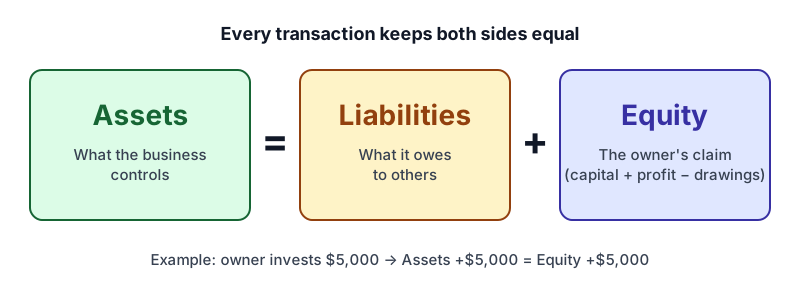
In a double-entry system, every transaction affects at least two accounts, and the total debits equal the total credits. The idea rests on the accounting equation: Assets = Liabilities + Equity. If cash goes up, something else must change too: revenue was earned, a loan was taken, or the owner put money in.
Publication 583 explains it the same way. Each account has a left side for debits and a right side for credits. The system is self-balancing because every transaction is recorded as a debit in one account and a credit in another.
Entries are recorded in a journal and then posted to the general ledger. A diagram helps:
If debits and credits are new to you, the lesson on debits and credits explained is the place to start, and double-entry bookkeeping covers the full method.
The same month in both systems
The clearest way to see the difference is to record one month both ways. A fictional dog-walking business, Riverbend Pet Care, has five transactions in June (figures are fictional):
- Borrows $2,000 from a bank on a note.
- Buys a $1,200 cargo bike for walks, paid in cash.
- Pays $500 rent for a small storage unit.
- Bills a client $900 for the month, payable in July.
- Collects $1,500 in cash from other clients for walks done in June.
The single-entry log
| Transaction | Income | Expense |
|---|---|---|
| Bank loan deposit | $2,000 | |
| Cargo bike | $1,200 | |
| Rent | $500 | |
| Client invoice (unpaid) | not recorded | |
| Cash from clients | $1,500 | |
| Total | $3,500 | $1,700 |
The log shows a June "profit" of $1,800. It is wrong in three ways. The loan is not income; it has to be paid back. The bike is not a June expense; it will be used for years. And the $900 invoice, earned in June, is missing because no cash arrived. If the owner had correctly left the loan out of income, the log would show a loss of $200, which is wrong in the other direction.
The double-entry journal
| Account | Debit | Credit |
|---|---|---|
| June 1: borrow from the bank | ||
| Cash | $2,000.00 | |
| Notes Payable | $2,000.00 | |
| June 2: buy a cargo bike for cash | ||
| Equipment | $1,200.00 | |
| Cash | $1,200.00 | |
| June 5: pay storage rent | ||
| Rent Expense | $500.00 | |
| Cash | $500.00 | |
| June 30: bill a client for June walks | ||
| Accounts Receivable | $900.00 | |
| Service Revenue | $900.00 | |
| June 30: cash collected for June walks | ||
| Cash | $1,500.00 | |
| Service Revenue | $1,500.00 | |
Each entry balances, so the ledger balances too. The trial balance at June 30 lists every account:
| Account | Debit | Credit |
|---|---|---|
| Cash | $1,800 | |
| Accounts receivable | 900 | |
| Equipment | 1,200 | |
| Notes payable | $2,000 | |
| Service revenue | 2,400 | |
| Rent expense | 500 | |
| Total | $4,400 | $4,400 |
Revenue is $2,400 and expenses are $500, so June profit before depreciation is $1,900. (In a real close, a month of depreciation on the bike would also be recorded as an expense; the straight-line depreciation lesson shows how.) The books also show the business holds $1,800 in cash, is owed $900, owns a $1,200 bike and owes the bank $2,000. The single-entry log knew none of that.
Why double-entry catches errors single-entry misses
A single-entry log has no internal check. If you type $580 instead of $850, for example, or forget an expense entirely, the totals still look fine, and nothing tells you something is wrong.
Double-entry adds three checks:
- The trial balance. Publication 583 notes that total debits must equal total credits after posting, and if they don't, you have made an error and must find and correct it. A one-sided entry or a debit typed differently from its credit shows up immediately.
- Balance sheet accounts that can be reconciled. Because cash, loans, receivables and payables each have their own account, you can compare them to bank, lender and customer statements every month.
- Control accounts and subledgers. The total owed by all customers in the receivables account should match the sum of the individual customer balances. The subledgers lesson explains how that comparison works.
Double-entry is not foolproof. An entry with the right amount in the wrong account still balances, and so does a transaction left out entirely. The lesson on errors a trial balance cannot find covers those cases, and reconciliations are how you catch them.
Side-by-side comparison
| Single-entry | Double-entry | |
|---|---|---|
| Records each transaction | Once | In two or more accounts |
| Main output | Income and expense totals | Income statement, balance sheet, trial balance |
| Tracks receivables, payables, loans, assets | No, only separately if at all | Yes, as accounts |
| Built-in error check | None | Debits must equal credits |
| Usual basis | Cash in and out | Accrual or cash |
| Effort to learn | Low | Moderate |
| Fits | Very small cash-only businesses | Most businesses, and anyone needing a balance sheet |
When single-entry is enough, and when to switch
Single-entry can be reasonable for a business such as a solo dog walker or tutor, when all of these are true: customers pay at the time of sale and you pay bills right away. There is no inventory, no loan and no significant equipment. And nobody outside the business needs a balance sheet.
Switch to double-entry when any of these appear:
- Customers on credit. You need accounts receivable to know who owes you what.
- Bills you pay later. Unpaid bills are accounts payable, a liability a cash log ignores.
- A loan or financed purchase. Only the interest is an expense; the principal reduces a liability.
- Equipment or inventory. Both are assets whose cost becomes an expense over time or when sold.
- A lender, investor or buyer asks for a balance sheet. A single-entry log can't produce one.
Accounting software typically records every transaction in double-entry form behind the scenes, even when the screen looks like a simple income and expense list. Knowing how the entries work is what lets you fix them when a categorization goes wrong. If you're moving from a log to full books, the sibling post on opening balances shows how to set the starting figures. The post on bookkeeping for freelancers sets out a simple monthly routine.
Frequently asked questions
Is single-entry the same as cash-basis accounting?
Not exactly, but they often go together. Single-entry describes how transactions are recorded (once, as income or expense). Cash basis describes when they are recorded (when cash moves). A double-entry system can use either basis; the accrual vs cash basis lesson explains the timing choice.
Does double-entry mean entering everything twice?
No. You record each transaction once, as one journal entry with two or more lines. The "double" refers to the two sides, debit and credit, not to typing the transaction twice.
Can I file taxes from single-entry records?
The IRS allows any system that clearly shows your income and expenses, as long as you keep the supporting documents. Whether your records are adequate for your situation is a question for a tax professional.
What to practice next
The quickest way to get comfortable with double-entry is to record a lot of small transactions. Start with the debit and credit practice, then move to the journal entry practice set to record full transactions like the five above.
Sources
Educational content for US small-business bookkeeping, not tax, legal or accounting advice. Example businesses and figures are fictional. See our editorial policy for how we write and correct content.