Bookkeeping by business type
Bookkeeping for freelancers: a simple monthly routine
A monthly bookkeeping routine for freelancers covering a separate account, invoices, expenses, a tax set-aside and a bank reconciliation, with entries.
By TNas · · 8 min read
Freelance bookkeeping comes down to one habit: once a month, record every invoice, payment and expense from a separate business account, set money aside for tax, and reconcile the account to the bank statement. With that routine, an hour or two a month keeps your books ready for tax time and tells you whether the work is actually paying.
Why freelancers need their own books
A freelancer is a self-employed person who sells services to clients without becoming their employee. The IRS self-employed individuals tax center says you are generally self-employed if you carry on a trade or business as a sole proprietor or an independent contractor. That includes part-time and gig work. It also says sole proprietors report business income and expenses on Schedule C (Form 1040), Profit or Loss from Business.
Schedule C asks for income and expenses by category. Bookkeeping is how you get those figures without a weekend of digging through receipts. It also answers everyday questions: who hasn't paid, what you spent on software this year, and how much of the money in the account is really yours to spend.
This routine assumes a one-person business taxed as a sole proprietor. If you have formed an LLC or corporation, or you're unsure how you are taxed, ask a tax professional; the bookkeeping steps are similar, but some equity accounts differ.
Set up once: account, categories and records
Open a separate business account
IRS Publication 583 says one of the first things to do when you start a business is open a business checking account. It also says to keep that account separate from your personal one. Every client payment goes in; every business cost comes out. Personal spending stays in the personal account. The post on keeping personal and business expenses apart covers what to do when they mix.
A business credit card used only for business does the same job for purchases.
Keep a short chart of accounts
A freelancer rarely needs more than 15 to 20 accounts. A chart of accounts for a solo designer might look like this:
| Type | Accounts |
|---|---|
| Assets | Cash – Checking; Cash – Tax Savings; Accounts Receivable; Equipment |
| Liabilities | Credit card payable |
| Equity | Owner Capital; Owner Drawings |
| Revenue | Service revenue |
| Expenses | Software expense; Bank fees expense; Supplies expense; Advertising expense; Travel expense; Phone and internet expense |
Use expense names that match how you think about your costs. You can map them to tax categories at year-end with your tax preparer.
Choose cash or accrual
On the cash basis you record income when the money arrives. On the accrual basis you record it when you send the invoice and track what clients owe in Accounts receivable. Accrual shows unpaid work clearly, which matters when clients pay late. The examples below use accrual; the accrual vs cash basis lesson compares the two.
The monthly routine at a glance
| When | Task | Time |
|---|---|---|
| As work finishes | Send and record invoices | A few minutes each |
| Weekly | Save receipts; record client payments | 15 minutes |
| Each payment | Move the tax share to tax savings | 2 minutes |
| Month-end | Record remaining expenses and fees | 30 minutes |
| Month-end | Reconcile checking, tax savings and credit card | 30 minutes |
| Month-end | Review profit and unpaid invoices | 15 minutes |
| Each tax period | Pay estimated tax from tax savings | 10 minutes |
The worked figures below are for a fictional freelance designer in March.
Step 1: record invoices and client payments
Record an invoice when you send it. On March 4 the designer bills a client $2,400 for a brand project:
| Account | Debit | Credit |
|---|---|---|
| March 4: invoice for brand design project | ||
| Accounts Receivable | $2,400.00 | |
| Service Revenue | $2,400.00 | |
When the client pays, money moves from receivables to cash. If the payment comes through a card processor or payment platform that deducts a fee, record the full invoice as paid and the fee as an expense. Here the client pays on March 18 and the processor keeps a fictional $72.00 fee:
| Account | Debit | Credit |
|---|---|---|
| March 18: client payment received net of processor fee | ||
| Cash – Checking | $2,328.00 | |
| Bank Fees Expense | $72.00 | |
| Accounts Receivable | $2,400.00 | |
Recording only the net $2,328 as revenue would understate both income and fees. The invoicing and accounts receivable lesson covers partial payments and other cases.
Step 2: record expenses with receipts
Each business cost needs a record of what it was and that it was for the business. Publication 583 says expense records should show the amount paid and that the amount was for a business expense. Snap a photo of each receipt the day you get it and note the client or purpose on it.
A design software subscription charged to the business checking account:
| Account | Debit | Credit |
|---|---|---|
| March 10: monthly design software subscription | ||
| Software Expense | $49.00 | |
| Cash – Checking | $49.00 | |
Larger purchases, like a new computer, may be equipment rather than an expense. The capitalizing fixed assets lesson explains how to decide.
Step 3: set aside money for tax
No employer withholds tax from freelance income, so you have to hold it back yourself. Two IRS rules explain why.
Self-employment tax
The IRS page on self-employment tax says you usually must pay it if you had net earnings from self-employment of $400 or more. The rate is made up of 12.4% for Social Security and 2.9% for Medicare. It is figured on Schedule SE, and you can deduct one-half of it when figuring adjusted gross income. This is on top of regular income tax.
Estimated tax payments
The IRS estimated taxes page says individuals, including sole proprietors, generally have to make estimated tax payments if they expect to owe tax of $1,000 or more when they file. They generally use Form 1040-ES to figure it. The year is divided into four payment periods, each with its own due date; the form's instructions list the dates.
Make it a transfer, not a guess
The simplest habit is to move a fixed share of every client payment into a separate tax savings account the day it arrives. How large that share should be depends on your income, deductions and other income, so work it out with a tax professional. Using a fictional 25% for illustration, the designer moves $582 of the March 18 payment:
| Account | Debit | Credit |
|---|---|---|
| March 18: move tax share to tax savings | ||
| Cash – Tax Savings | $582.00 | |
| Cash – Checking | $582.00 | |
This entry changes nothing on the income statement. It just moves money between two bank accounts you own.
Recording the estimated tax payment
For a sole proprietor, federal income tax and self-employment tax are personal taxes of the owner, not business expenses. When the designer pays a fictional $1,650 estimated payment from tax savings, it is recorded as a drawing:
| Account | Debit | Credit |
|---|---|---|
| Estimated tax payment from the tax savings account | ||
| Owner Drawings | $1,650.00 | |
| Cash – Tax Savings | $1,650.00 | |
The glossary entry on owner drawings explains why drawings reduce equity without being expenses.
Step 4: pay yourself
Freelancers who work as sole proprietors don't put themselves on payroll. They take money out as drawings. Pick a regular amount you can sustain, transfer it from business to personal checking, and record it:
| Account | Debit | Credit |
|---|---|---|
| March 31: owner's monthly draw | ||
| Owner Drawings | $1,500.00 | |
| Cash – Checking | $1,500.00 | |
Taking a fixed draw each month, after the tax share is set aside, keeps the business account from drifting to zero between client payments.
Step 5: reconcile and review at month-end
Reconcile every account
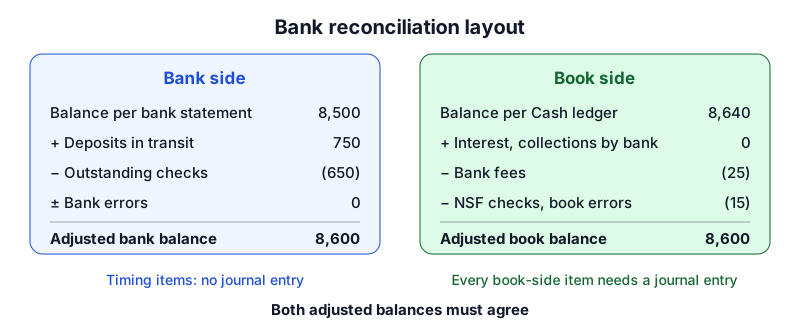
Compare each account in your books with its statement: business checking, tax savings and the credit card. A bank reconciliation proves nothing is missing or doubled. For the designer, the March statement should show the $2,328 deposit, the $49 subscription, the $582 transfer and the $1,500 draw. The bank reconciliation steps guide walks through the process.
Worked example: the month in numbers
Suppose the designer also invoiced a second client $1,800 on March 25, still unpaid at month-end. March then looks like this:
| Measure | Amount | How it's built |
|---|---|---|
| Revenue | 4,200.00 | $2,400 + $1,800 invoiced |
| Expenses | 121.00 | $72 fees + $49 software |
| Profit | 4,079.00 | Revenue minus expenses |
| Change in checking | 197.00 | $2,328 in, less $49, $582 and $1,500 out |
| Tax savings added | 582.00 | Transfer on March 18 |
| Still owed by clients | 1,800.00 | Accounts receivable at March 31 |
Profit was $4,079, but checking grew by only $197. The gap is the unpaid invoice, the tax set-aside and the owner's draw, none of which are expenses. Seeing those figures side by side is the point of the monthly routine: profit says the work is paying, while receivables and the tax balance say how much cash you can actually spend.
Review three numbers
- Profit for the month and year to date. Revenue minus expenses, from your income statement.
- Unpaid invoices. List what each client owes and how old it is. Send reminders for anything past its due date.
- Tax savings balance. Check it covers your next estimated payment.
Step 6: keep the records
Store invoices, receipts, bank statements and tax payment confirmations together by month. The IRS page on how long to keep records sets out the periods; three years applies in many common situations, and some records must be kept longer. A full year of tidy months makes Schedule C a summary job instead of a search.
Frequently asked questions
Do I need accounting software as a freelancer?
Not necessarily. A spreadsheet works if you record every transaction with its date, amount, account and description, and reconcile monthly. Software helps once invoices and transactions grow.
Are estimated tax payments a business expense?
Not for a sole proprietor. Federal income tax and self-employment tax are the owner's personal taxes, so record payments from the business account as owner's drawings. Ask a tax professional about your situation.
What if I forgot to set aside tax for several months?
Calculate what you should have set aside, transfer it now if you can, and talk to a tax professional about your next estimated payment.
If you are deciding how formal your records need to be, see single-entry vs double-entry bookkeeping.
What to practice next
The routine rests on a few entries done well: invoices, payments with fees, expenses and draws. Practice them in the journal entry practice set, then try the freelance design studio project to run a full month for a solo business.
Sources
- Self-employed individuals tax center — IRS
- Estimated taxes — IRS
- Topic no. 554, Self-employment tax — IRS
- Publication 583, Starting a Business and Keeping Records — IRS
- How long should I keep records? — IRS
Educational content for US small-business bookkeeping, not tax, legal or accounting advice. Example businesses and figures are fictional. See our editorial policy for how we write and correct content.