Bookkeeping by business type
Bookkeeping for rental property owners
Record rent, security deposits, repairs and improvements, mortgage payments split into interest and principal, and depreciation, tracked per property.
By TNas · · 7 min read
Bookkeeping for a rental property means recording rent as income, holding security deposits as a liability, splitting each mortgage payment into interest expense and principal, and separating everyday repairs from improvements that get capitalized. Depreciation spreads the building's cost (not the land's) over its useful life. Keep every one of these by property, so each unit or building has its own results.
The examples follow a fictional landlord, Dana Ortiz, who owns a two-unit rental building. All names and amounts are invented.
Set up the books for each property
Start with a separate bank account for the rentals, used for nothing else. Mixing rent with personal spending makes every later step harder, especially sorting deductible expenses at tax time.
Then set up a short chart of accounts, and tag each transaction to a property (and to a unit if you want that detail).
| Account | Type | Notes |
|---|---|---|
| Cash – Rental Operating | Asset | Separate bank account for the rentals |
| Land | Asset | Not depreciated |
| Building | Asset | Depreciated |
| Building Improvements | Asset | Capitalized improvements, depreciated |
| Accumulated Depreciation – Building | Contra asset | Total depreciation to date |
| Security Deposits Held | Liability | Deposits owed back to tenants |
| Mortgage Payable | Liability | Loan principal still owed |
| Rental Income | Revenue | Rent and fees from tenants |
| Repairs and Maintenance Expense | Expense | Ordinary repairs |
| Mortgage Interest Expense | Expense | Interest part of each payment |
| Property Tax, Insurance, Utilities | Expense | One account each |
| Depreciation Expense | Expense | Annual depreciation |
The IRS reports rental real estate income and expenses on Schedule E (Form 1040), and Topic 414 notes that a landlord who provides substantial services mainly for the tenant's convenience uses Schedule C instead (IRS, Topic no. 414). Tracking by property in the books makes the per-property figures easy to pull out at year-end.
Recording rent and security deposits
When a tenant pays rent for the current month, it's straightforward income.
| Account | Debit | Credit |
|---|---|---|
| March 1: Unit A rent received | ||
| Cash – Rental Operating | $1,450.00 | |
| Rental Income | $1,450.00 | |
Security deposits are not income
A security deposit is money a tenant pays up front that the landlord must return at the end of the lease, minus any amounts the lease allows the landlord to keep. Because you may have to give it back, it's a liability, not income.
| Account | Debit | Credit |
|---|---|---|
| March 1: security deposit from new Unit B tenant | ||
| Cash – Rental Operating | $1,450.00 | |
| Security Deposits Held | $1,450.00 | |
This matches IRS guidance: Publication 527 says not to include a security deposit in income when you receive it if you plan to return it at the end of the lease. If you keep part or all of it because the tenant doesn't live up to the lease, the amount kept is income for that year (IRS, Publication 527). State and local laws may also set rules for holding deposits, so check the rules where your property is.
Later, the Unit B tenant breaks the lease early. Under the lease, Dana keeps $700 and returns $750.
| Account | Debit | Credit |
|---|---|---|
| Tenant breaks lease: part of deposit kept, rest returned | ||
| Security Deposits Held | $1,450.00 | |
| Cash – Rental Operating | $750.00 | |
| Rental Income | $700.00 | |
If you keep a deposit to pay for damage instead, the IRS says the treatment depends on how you handle the repair costs, so ask a tax professional before recording it.
Rent paid in advance
On accrual books, rent received in December for January is unearned revenue until January, and an adjusting entry moves it to Rental Income in January. For taxes, the IRS says advance rent is generally income in the year you receive it, regardless of the period it covers (IRS, Topic no. 414). Topic 414 also notes that most individuals use the cash method, which is why many landlords keep their books on the cash basis. Whichever basis you use, apply it consistently and tell your tax preparer.
Splitting mortgage payments
A mortgage payment isn't one expense. Part of it is interest, which is an expense, and part is principal, which pays down the loan. The lender's monthly statement or the amortization schedule shows the split.
Dana's March payment is $1,320.00: $905.00 of interest and $415.00 of principal.
| Account | Debit | Credit |
|---|---|---|
| March mortgage payment split from the lender statement | ||
| Mortgage Interest Expense | $905.00 | |
| Mortgage Payable | $415.00 | |
| Cash – Rental Operating | $1,320.00 | |
Publication 527 says you can deduct mortgage interest on rental property but can't simply deduct the mortgage or principal payments as an expense. Recording the full payment as an expense is a common rental bookkeeping error; it understates profit and leaves the loan balance overstated on the balance sheet. If the payment includes escrow for property tax and insurance, record that part in an escrow asset account, then expense the tax and insurance when the lender pays them.
At year-end, compare the Mortgage Payable balance with the lender's statement. If they differ, part of a payment was probably posted to the wrong account. The lesson on split lines and allocation covers entries like this one, and how to record a business loan covers loan entries in more depth.
Repairs or improvements?
This is the judgment call that matters most in rental books. A repair keeps the property in good working condition without adding to its value or life, such as fixing a leak or replacing a broken lock. An improvement is capitalized: Publication 527 says you must capitalize an expense that results in a betterment to the property, restores it, or adapts it to a new use (IRS, Publication 527).
| Publication 527 category | What it includes |
|---|---|
| Betterment | Fixing a pre-existing defect, enlarging the property, or increasing its capacity, strength or quality |
| Restoration | Includes replacing a substantial structural part of the property |
| Adaptation | Altering the property to a use not consistent with its ordinary use when you began renting it |
A plumber clearing a drain is a repair:
| Account | Debit | Credit |
|---|---|---|
| Plumber clears a blocked drain in Unit A | ||
| Repairs and Maintenance Expense | $275.00 | |
| Cash – Rental Operating | $275.00 | |
Adding a deck to the building enlarges the property, so it's an improvement and goes to an asset account to be depreciated.
| Account | Debit | Credit |
|---|---|---|
| New deck added to the building | ||
| Building Improvements | $14,800.00 | |
| Cash – Rental Operating | $14,800.00 | |
Publication 527 also tells landlords to separate the costs of repairs and improvements and keep accurate records, because improvement costs are needed for depreciation and when the property is sold. Keep the invoices and a short note on why each large job was treated as one or the other. The lesson on capitalizing fixed assets explains the general rule behind this.
Depreciation: building yes, land no
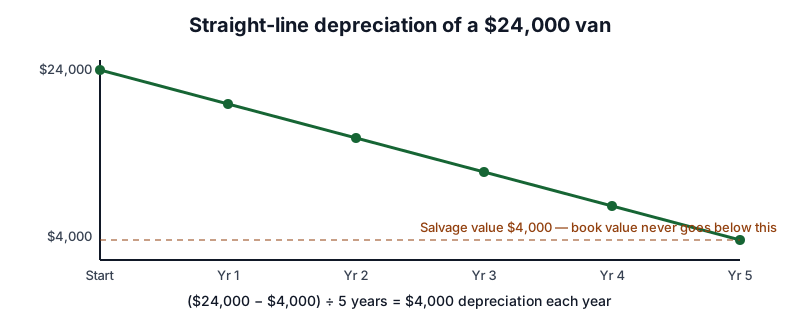
Depreciation spreads the cost of a long-lived asset over the years it's used. For a rental, only the building and improvements are depreciated. Publication 527 says land can't be depreciated because it doesn't wear out, become obsolete or get used up, so the purchase price must be split between land and building first. Topic 414 says depreciation begins when the property is placed in service.
Dana bought the building for $330,000, and $55,000 of that is allocated to land. The depreciable building cost is $275,000. Publication 527 states a 27.5-year recovery period for residential rental property under the general depreciation system, so straight-line depreciation for a full year is $275,000 ÷ 27.5 = $10,000.
| Account | Debit | Credit |
|---|---|---|
| December 31: a full year of building depreciation | ||
| Depreciation Expense | $10,000.00 | |
| Accumulated Depreciation – Building | $10,000.00 | |
This is a simplified full-year figure. Tax depreciation follows specific IRS conventions for the first and last years and is figured on Form 4562, so your tax preparer may compute a different first-year amount. One simple approach is to record the preparer's figure in the books at year-end so the two agree. See straight-line depreciation and accumulated depreciation for how the entry works.
A monthly routine for landlords
| Step | What to do |
|---|---|
| 1. Rent roll | Check each unit's rent received against the lease; follow up late payments |
| 2. Record expenses by property | Tag repairs, utilities, insurance and tax to the right property |
| 3. Split the mortgage | Use the lender statement for interest, principal and escrow |
| 4. Review large invoices | Decide repair or improvement and file the reason |
| 5. Reconcile the bank | Match every deposit and payment; see bank reconciliation basics |
| 6. Check Security Deposits Held | Balance equals the deposits listed in current leases |
The last check is the easiest to skip and one of the most useful. If Security Deposits Held doesn't equal the total of deposits in current leases, a deposit was recorded as rent, or a returned deposit was expensed.
Frequently asked questions
Is rent received in advance income?
For taxes, the IRS says advance rent is generally income in the year you receive it. On accrual books, it's held as unearned revenue until the month it covers. Ask a tax professional how to reconcile the two for your return.
Can I expense the whole mortgage payment?
No. Only the interest part is an expense. The principal part reduces Mortgage Payable.
Do I need separate books for each property?
You don't need separate files, but you do need each transaction tagged to a property. That gives you per-property profit and the figures needed for each property on Schedule E.
Job-based businesses track costs differently; see bookkeeping for contractors.
What to practice next
Rental books rely on the same basic entries as any business. Practice them in the journal entry practice, then work through the depreciation exercises and the adjusting entries practice for prepaid rent and year-end depreciation. The depreciation examples guide has more worked schedules, and the sibling post on security deposits paid and received covers deposits from both sides.
Sources
- Topic no. 414, Rental income and expenses — IRS
- Publication 527 (2025), Residential Rental Property — IRS
Educational content for US small-business bookkeeping, not tax, legal or accounting advice. Example businesses and figures are fictional. See our editorial policy for how we write and correct content.